
Practical overview
When it fits
Use it as a hands-on companion while studying AI product-serving lessons, especially when choosing among batch, online, containerization, or model-management topics.
Who it is for
- Learners following Boostcamp AI Tech Product Serving lessons who want to write and adapt code.
- Python practitioners studying batch or online inference, containerization, and model management.
Documented uses
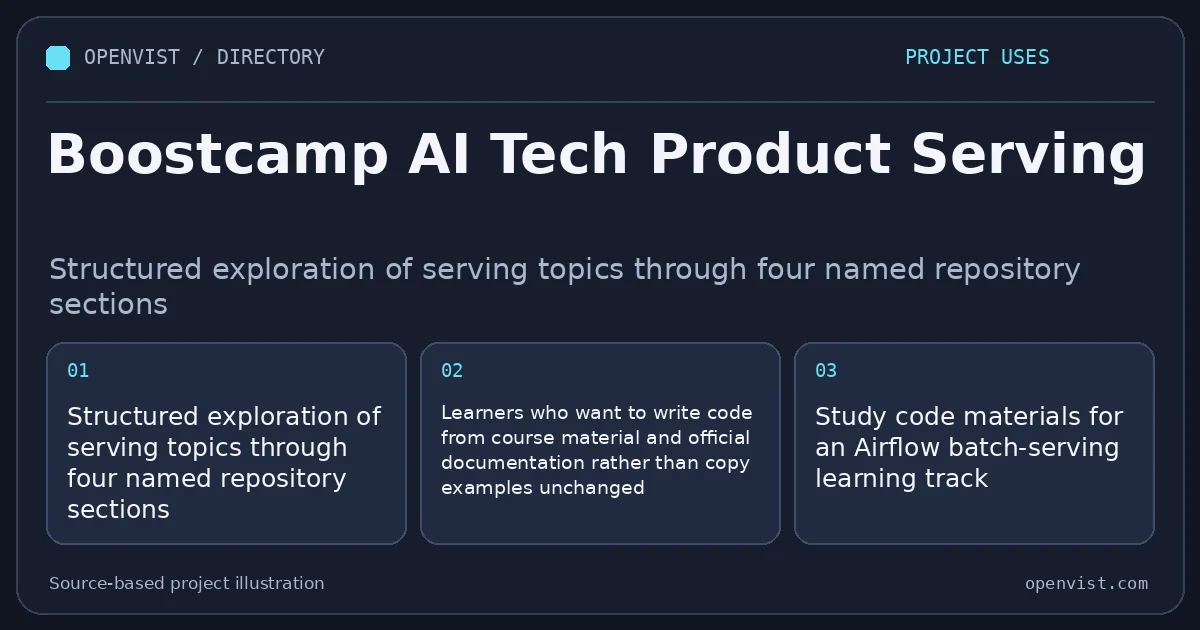
- Study code materials for an Airflow batch-serving learning track.
- Explore online-serving lessons organized around FastAPI.
- Work through Docker and MLflow sections as part of serving and model-management study.
- Use course-related examples as a starting point for improving code and keeping personal serving notes.
Requirements & limits
The repository is public on GitHub.
- The README recommends taking the course and consulting the relevant official documentation alongside the code.
- The repository is learning material, not a hosted model-serving service or API.
- The README directs practice-code questions to a Slack channel and course-video or course-material questions to Boostcourse.
Check current requirements in the official documentation. Source-based guidance does not mean OpenViST has run or independently tested this project.
Study the Product Serving code repository
Use the repository as a companion for studying the course’s Product Serving materials.
Before you start
- Access to the repository and the relevant course materials.
Steps
Review the course material, then consult the official documentation for the topics covered.
Write the code yourself rather than copying and pasting the lecture code.
Record errors encountered, their causes, and how they were resolved.
Consider improving the lecture code or researching related topics for personal serving notes.
Expected outcome
A self-written set of serving study code and notes informed by course materials and official documentation.
Guide limitations
- The README identifies code directories for batch serving with Airflow, online serving with FastAPI, Docker, and model management with MLflow, but does not document how to run them.
- For code-practice questions, the README directs learners to the Slack channel; questions about lecture videos and materials should go through Boostcourse.
Compare options for Model inference and serving
These projects document a common task and share a project role. This is a source-based comparison, not an execution benchmark or a guarantee of interchangeability.
| Project | Documented purpose | Platform | Access and requirements |
|---|---|---|---|
| Boostcamp AI Tech Product Serving | Study code materials for an Airflow batch-serving learning track. | Cloud, Server, Docker | The repository is public on GitHub. |
| Rten | Load an ONNX model and run CPU inference from Rust. | Linux, macOS, Windows, Server | |
| Moe Infinity | Serve MoE models whose expert weights do not all fit in GPU memory. | Linux, Server, Self-hosted | The repository is public and identifies its license as Apache-2.0. Installation documentation specifies Python 3.10 or later and a CUDA-capable GPU. |
Sources & review
Source record details
- Source availability
- Active
- Sources checked
- 23 October 2026
- Original website title
- zzsza/Boostcamp-AI-Tech-Product-Serving · Official homepage title · retained in its source language