
Practical overview
When it fits
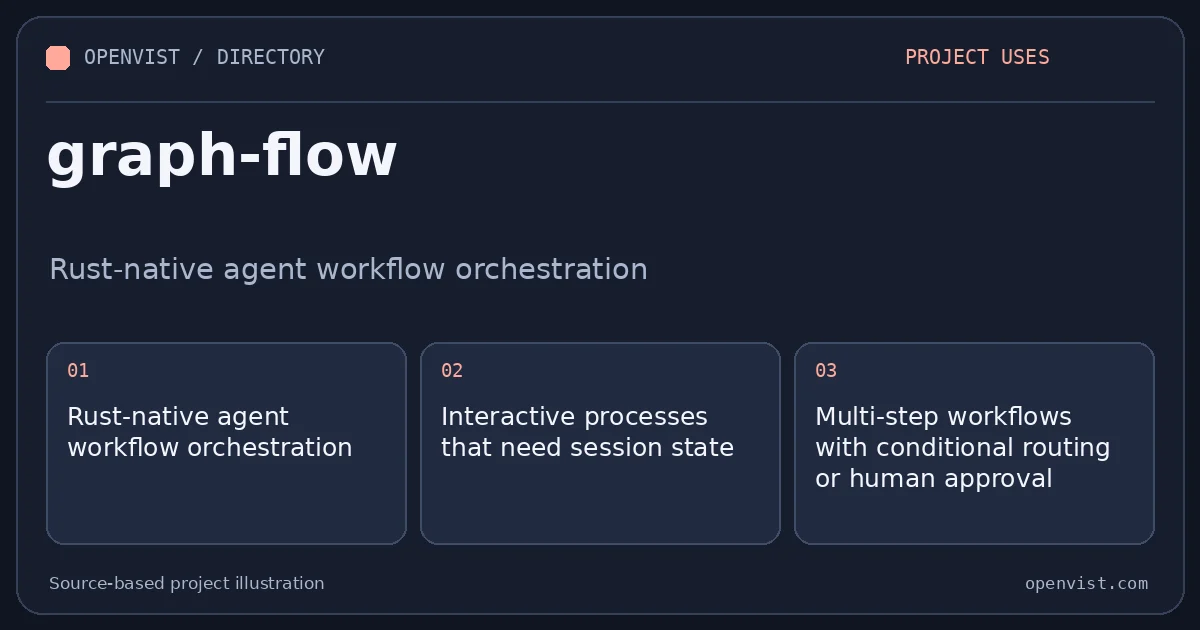
Use it when an AI-agent process needs explicit graph-based orchestration, state carried between tasks, or pauses and resumptions around user input.
Who it is for
- Rust developers structuring agent work as connected tasks.
- Teams that need workflow state and sessions that can be paused and resumed.
- Builders integrating Rust-based LLM workflows with Rig.
Documented uses
- Define tasks that read and update shared workflow context.
- Connect tasks into graphs and route execution conditionally.
- Persist workflow sessions and manage stepwise or continuing execution.
- Pause a workflow for human input and resume it later.
Requirements & limits
The repository is public, and its metadata identifies an MIT license.
- The core framework is distinct from the companion Rig agent runtime; Rig integration is an optional feature.
- PostgreSQL session storage is enabled by default; the README also shows in-memory session storage.
- The README describes resumption across process restarts when persistent storage is used.
- Execution can be controlled step by step, continued through tasks, paused for input, directed to a task, or ended.
Check current requirements in the official documentation. Source-based guidance does not mean OpenViST has run or independently tested this project.
Set up a Rust workflow with graph-flow
Add the framework and its documented optional Rig integration as project dependencies.
Before you start
- A Rust project using the Tokio asynchronous runtime.
- For the documented LLM integration, use the Rig feature with rig-core and rig-agent.
Steps
Add graph-flow version 0.8 to the Cargo dependencies.
Enable the rig feature if you need the documented Rig message integration.
Add Tokio with the macros and multi-thread runtime features shown in the README.
For Rig integration, add rig-core and rig-agent version 0.42.
Expected outcome
The project manifest contains the framework and the selected async-runtime and LLM-integration dependencies.
Guide limitations
- This covers dependency setup only; it does not implement or execute a workflow.
- The README says PostgreSQL support is enabled by default and can be excluded with default-features = false.
Compare options for Agent orchestration
These projects document a common task and share a project role. This is a source-based comparison, not an execution benchmark or a guarantee of interchangeability.
| Project | Documented purpose | Platform | Access and requirements |
|---|---|---|---|
| graph-flow | Define tasks that read and update shared workflow context. | Linux, macOS, Windows | The repository is public, and its metadata identifies an MIT license. |
| Ernie SDK | Create a conversational agent that selects and invokes tools. | Linux, Windows, macOS | The quick-start requires an AI Studio account and access token. The repository documents Python 3.8 or later and Linux, Windows and macOS. Both components are identified as Apache-2.0 licensed. |
| Agenticle | Define agents with descriptions, model endpoints and task-specific tools. | CLI |
Sources & review
Source record details
- Source availability
- Active
- Sources checked
- 16 November 2026
- Original website title
- a-agmon/rs-graph-llm · Official homepage title · retained in its source language