
Practical overview
When it fits
Use BRAIN0 when you have a Git repository and want an inspectable connection between AI-assisted changes and the prompts or transcript-recorded inputs behind them.
Who it is for
- Developers investigating the prompt or agent session behind a code change
- Teams reviewing differences between an agent’s stated work and its actual Git changes
- Repository maintainers auditing which files coding-agent sessions recorded as read
Documented uses
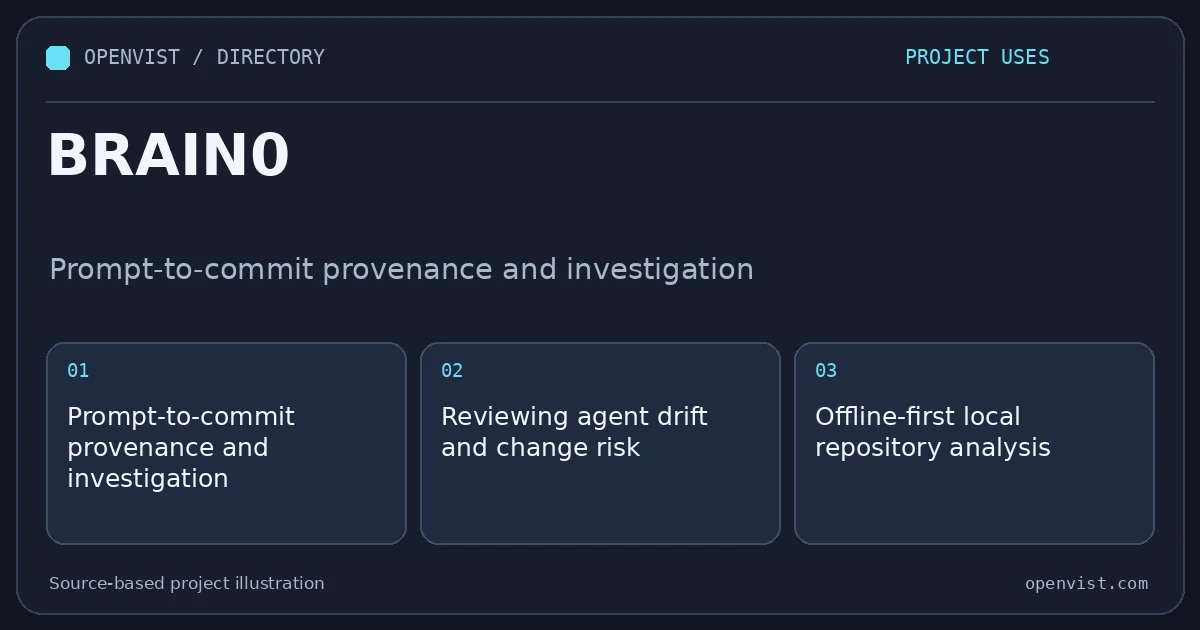
- Trace a commit or function back to the prompt behind it.
- Compare an agent’s declared changes with the resulting diff.
- Review recorded file reads for sensitive-data indicators.
- Triage recent agent changes and query repository history for debugging context.
- Expose repository decision history to coding agents through MCP memory.
Requirements & limits
The project is open source under the Apache-2.0 license. Its documented quickstart requires Node.js 20 or later and opens a local GUI at http://localhost:8787.
- Git history provides the commit and code side; without Git, the documented alternative is filesystem checkpoint mode.
- Codex and Claude Code transcript locations are auto-discovered for the intent and read-audit layer.
- BRAIN0 can operate offline with deterministic summaries and local feature-hash embeddings; Ollama adds model-written summaries, semantic search and smart chat.
- The sensitive-read audit reflects the transcript-recorded read set, which the project describes as a lower bound rather than proof of all model inputs.
- The repository identifies Rust as the core language and TypeScript as the GUI language.
Check current requirements in the official documentation. Source-based guidance does not mean OpenViST has run or independently tested this project.
Set up a local repository decision graph
Start BRAIN0 from a Git repository and open its local graph view.
Before you start
- Node.js 20 or later
- A Git repository; Git is needed for commit-history indexing
- On Linux, glibc 2.28 or later; musl/Alpine is not supported
Steps
From the repository, run the command below.
npx brain0 upBRAIN0 infers the repository ID from its Git remote and indexes Git history.
If Codex or Claude Code session data is present in the documented locations, BRAIN0 auto-discovers and ingests those sessions.
Open the GUI at
http://localhost:8787to explore the graph and inspect commit prompts, per-file diffs and risk.
Expected outcome
A local, explorable repository graph; agent prompts and input-read details are included when supported session transcripts are available.
Guide limitations
- Without a coding-agent transcript, the graph contains commits and code but not the prompt, drift and read-audit layer.
- Agent reads are derived from transcripts and represent a lower bound, not a complete account of what may have reached a model.
- Ollama and local models are not required for the offline-first baseline.
Compare options for AI coding assistance
These projects document a common task and share a project role. This is a source-based comparison, not an execution benchmark or a guarantee of interchangeability.
| Project | Documented purpose | Platform | Access and requirements |
|---|---|---|---|
| BRAIN0 | Trace a commit or function back to the prompt behind it. | CLI, Linux, macOS, Windows, Self-hosted | The project is open source under the Apache-2.0 license. Its documented quickstart requires Node.js 20 or later and opens a local GUI at http://localhost:8787. |
| Harness Score | Measure the presence and structure of agent guidance, skills, hooks, feedback tools and safeguards. | CLI | The project is documented as a CLI and is MIT-licensed. The README shows invocation through `npx harness-score` and references a GitHub Action. |
| Agenttrail | See which project components and files are changing. | CLI, Desktop | Kitchen setup requires Node.js 20 or later, a browser with WebGL and a local project folder. The README describes Kitchen as a public experimental preview. |
Sources & review
Source record details
- Source availability
- Active
- Sources checked
- 20 November 2026
- Original website title
- Brain0-ai/brain0 · Official homepage title · retained in its source language