
Practical overview
When it fits
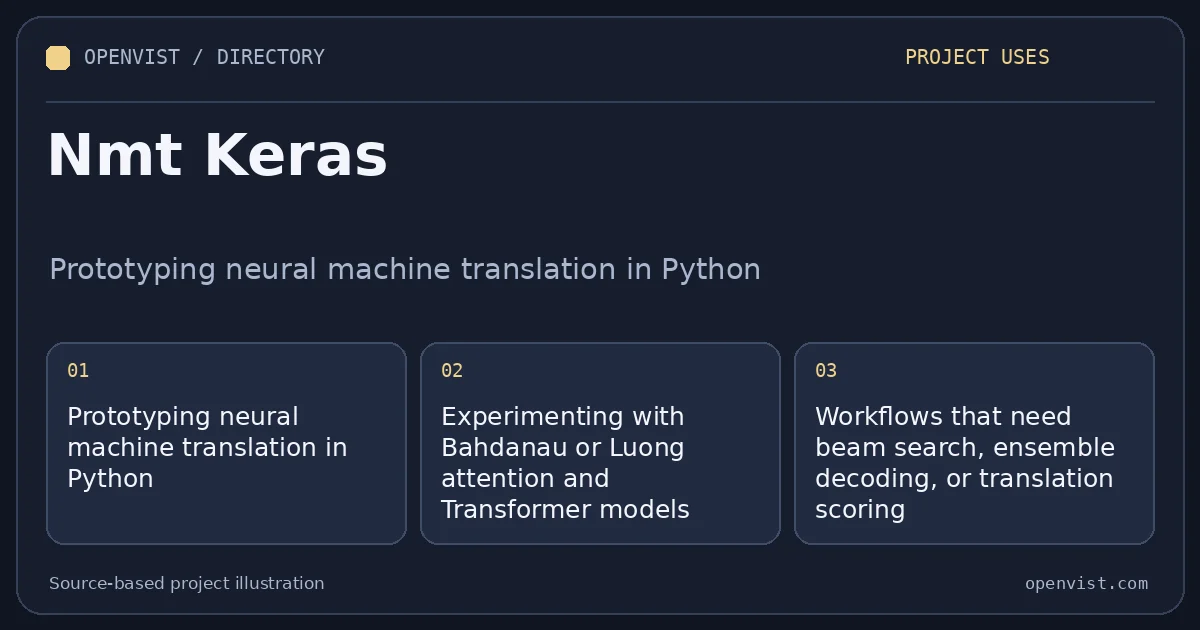
Use it when you need a code-level toolkit to train, decode, or score neural machine translation models, rather than a hosted interface for one-off translation.
Who it is for
- Developers prototyping neural machine translation systems in Python and Keras.
- Researchers experimenting with attention-based recurrent or Transformer translation models.
- Teams that need model decoding or source–target scoring within a code-based workflow.
Documented uses
- Configure and train a neural translation model.
- Translate text using trained models, including ensemble decoding.
- Score source–target sentence pairs with model probabilities.
- Explore recurrent attention and Transformer model approaches.
Requirements & limits
The public GitHub repository identifies the project as MIT-licensed and open source.
- The documented installation requires the project’s Keras variant and Multimodal Keras Wrapper, with specified recommended versions.
- The README identifies Python 3.7; check the project documentation for environment details relevant to your setup.
- Multi-GPU training is documented for TensorFlow only; CuDNN and CuPy are optional for CUDA acceleration.
- Additional evaluation metrics such as Meteor and TER use the Coco-caption evaluation package, which requires Java 1.8.0 or newer.
Check current requirements in the official documentation. Source-based guidance does not mean OpenViST has run or independently tested this project.
Install Nmt Keras from its repository
Install the library in editable mode using the documented pip workflow.
Before you start
- pip updated to a version newer than 18
- The project’s Keras version, recommended at 2.0.7 or newer
- Multimodal Keras Wrapper version 2.0 or newer
Steps
Clone the nmt-keras repository.
Change into the nmt-keras directory.
Run pip install -e .
Expected outcome
The library is installed from the cloned repository in editable mode.
Guide limitations
- This covers installation only; the README does not establish that dependencies are compatible with every environment.
- CuDNN and CuPy are optional additions for CUDA GPU acceleration.
Configure and train a translation model
Use the documented project workflow to configure and start model training.
Before you start
- Nmt Keras installed with its required libraries
- A training configuration in config.py, or parameters supplied to main.py
Steps
Set training parameters in config.py, consulting the project’s configuration documentation as needed.
Run python main.py to start training.
Expected outcome
The training script is invoked with the selected configuration.
Guide limitations
- The README does not specify dataset preparation steps or guarantee training results.
- CUDA acceleration is optional and requires CuDNN and CuPy.
Sources & review
Source record details
- Source availability
- Active
- Sources checked
- 11 November 2026
- Original website title
- lvapeab/nmt-keras · Official homepage title · retained in its source language