
Practical overview
When it fits
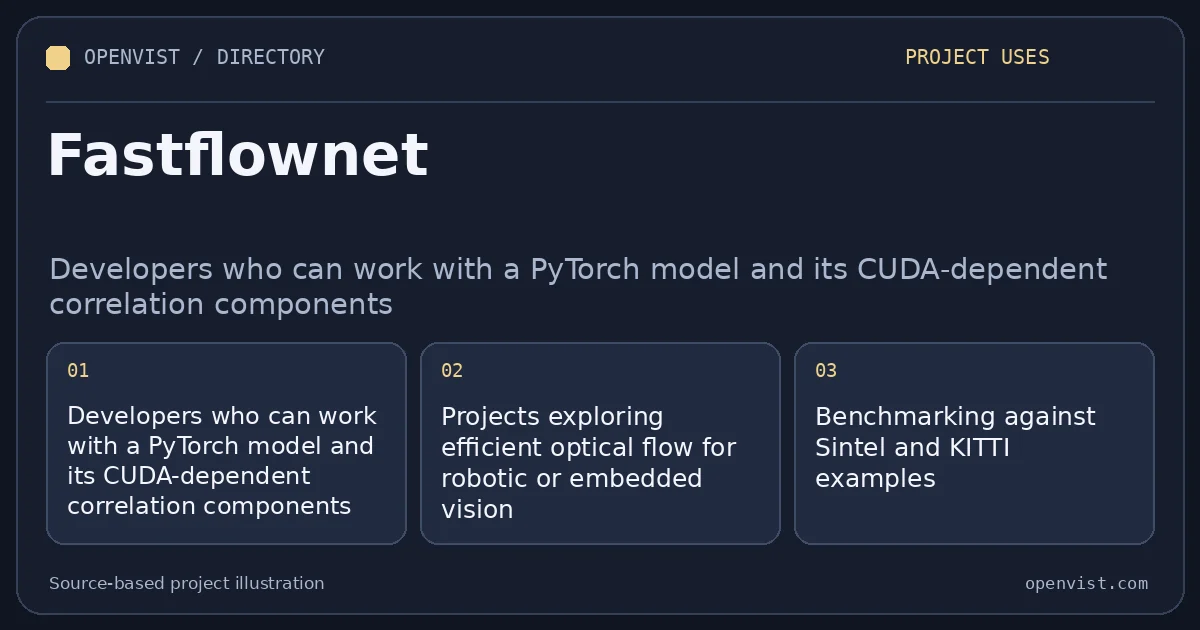
Use it when you need a code-based optical-flow model to evaluate or incorporate into a computer-vision pipeline, particularly for image-pair motion estimation.
Who it is for
- Computer-vision developers building motion-estimation pipelines.
- Robotics practitioners who need optical-flow estimates from camera images.
- Researchers evaluating flow models on Sintel or KITTI.
Documented uses
- Estimate dense motion between two time-adjacent images.
- Benchmark optical-flow inference speed and model parameter count.
- Evaluate model behavior on Sintel and KITTI data.
Requirements & limits
The repository is public and lists an MIT license.
- The README gives separate model variants and dependency versions for specified CUDA and PyTorch releases.
- TensorRT instructions describe one configuration: RTX 3060 Ti, driver 470.103.01, CUDA 11.3, TensorRT 8.0.1 GA and PyTorch 1.10.2+cu113.
- Reported performance is tied to specified hardware and Sintel-resolution benchmark conditions.
Check current requirements in the official documentation. Source-based guidance does not mean OpenViST has run or independently tested this project.
Run the image-pair optical-flow demo
Use the repository’s documented demo to predict optical flow from two adjacent images.
Before you start
- A copy of the FastFlowNet repository.
- A compatible Python, CUDA and PyTorch environment; the README lists the original environment as Python 3.6, CUDA 9.0 and PyTorch 0.4.1.
- The Correlation module built and installed from ./models/correlation_package/.
Steps
Build the Correlation module with python setup.py build from its directory.
Install it with python setup.py install.
Run python demo.py to predict optical flow for two time-adjacent images.
Expected outcome
The demo predicts optical flow from a pair of adjacent images.
Guide limitations
- The README specifies alternate model files and spatial-correlation-sampler versions for particular CUDA and PyTorch versions.
- The documented demo uses time-adjacent images; the README does not describe a general service interface.
Compare options for Model inference and serving
These projects document a common task and share a project role. This is a source-based comparison, not an execution benchmark or a guarantee of interchangeability.
| Project | Documented purpose | Platform | Access and requirements |
|---|---|---|---|
| Fastflownet | Estimate dense motion between two time-adjacent images. | Linux, Docker | The repository is public and lists an MIT license. |
| Esanet | Generate semantic labels from paired color and depth images. | Linux | The public repository states that its source code is licensed under Apache 2.0. |
| Ling V2 | Generate text from chat prompts using Ling-mini-2.0 and Transformers. | The repository is public and identifies the project as open source under the MIT license. Model downloads are linked through Hugging Face and ModelScope. |
Sources & review
Source record details
- Source availability
- Active
- Sources checked
- 19 November 2026
- Original website title
- ltkong218/FastFlowNet · Official homepage title · retained in its source language