
Practical overview
When it fits
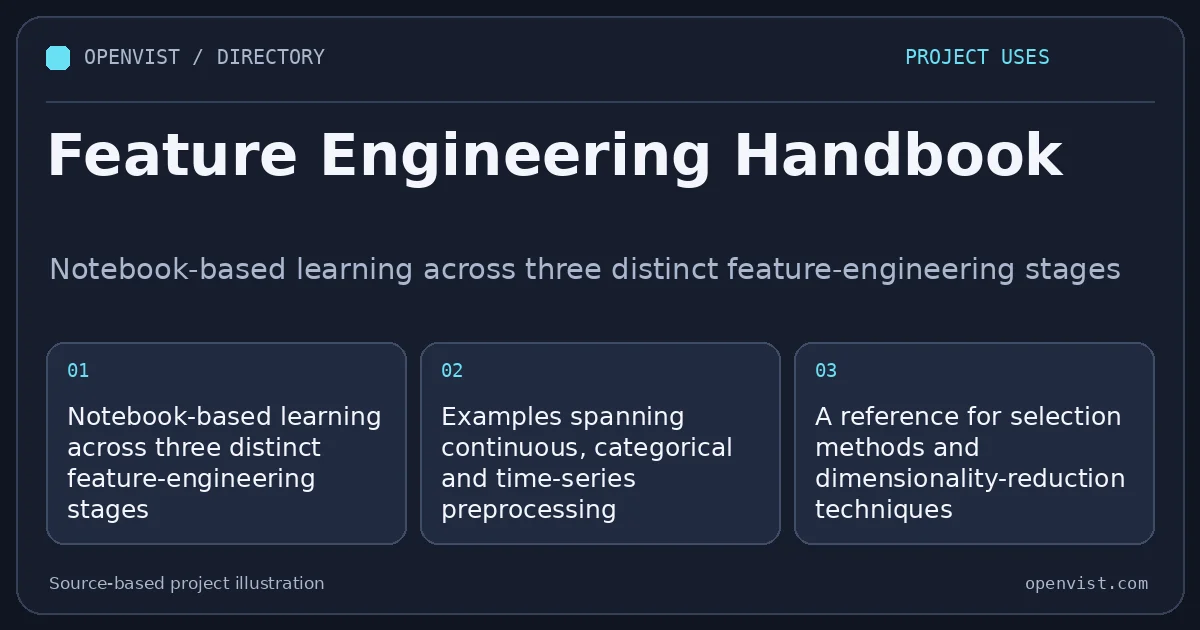
Use the handbook when learning or reviewing feature-engineering methods and you want separate notebooks for preprocessing, selection and dimensionality reduction.
Who it is for
- Machine-learning learners studying feature engineering concepts.
- Practitioners looking for notebook examples of preprocessing, feature selection or dimensionality reduction.
Documented uses
- Review methods for scaling, imputing, transforming and encoding features.
- Compare filter, wrapper and embedded feature-selection approaches.
- Study supervised and unsupervised dimensionality-reduction examples.
- Reference the repository's simulated annealing and genetic algorithm scripts.
Requirements & limits
The materials are available in a public GitHub repository. Working through the notebooks requires a Jupyter environment and relevant Python libraries; no setup instructions are described in the README.
- The tutorial separates its topics into three notebooks rather than presenting a single end-to-end workflow.
- The README identifies scikit-learn, Category Encoders, Featuretools and scikit-feature for different parts of the examples.
- Python scripts accompany the simulated annealing and genetic algorithm feature-selection material.
Check current requirements in the official documentation. Source-based guidance does not mean OpenViST has run or independently tested this project.
Explore feature engineering topics in the notebooks
Use the handbook’s three separate Jupyter notebooks to study data preprocessing, feature selection, and dimension reduction.
Before you start
- Access to the repository’s Jupyter notebooks.
Steps
Open the Data Preprocessing notebook to review preprocessing for static continuous and categorical features and time-series features.
Open the Feature Selection notebook to review filter, wrapper, and embedded methods.
Open the Dimension Reduction notebook to review supervised and unsupervised methods.
Expected outcome
A structured tutorial covering the three feature engineering topics, with each topic presented in its own notebook.
Guide limitations
- The README describes tutorial coverage; it does not specify notebook execution instructions or dependencies.
- The Simulated Annealing and Genetic Algorithm implementations are provided as Python scripts for reference.
Sources & review
Source record details
- Source availability
- Active
- Sources checked
- 20 November 2026
- Original website title
- YC-Coder-Chen/feature-engineering-handbook · Official homepage title · retained in its source language