
Practical overview
When it fits
Use MegaDLMs when you need a code-based GPU training framework for diffusion or autoregressive language models and can prepare the required server environment and tokenized data.
Who it is for
- Research and engineering teams training diffusion language models on GPU servers.
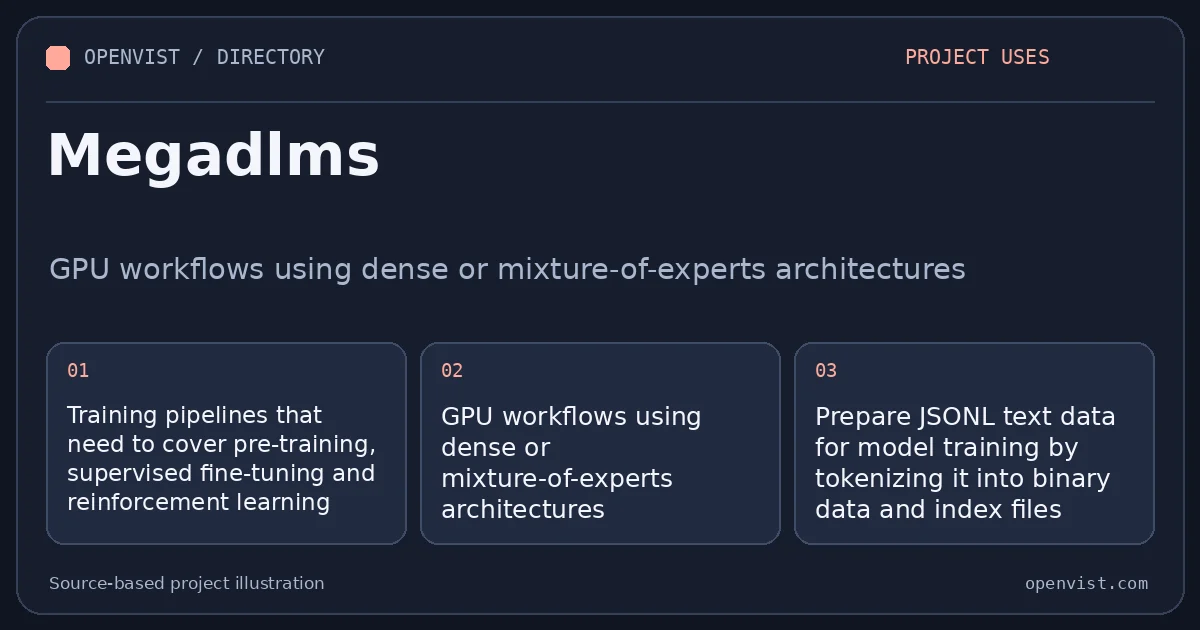
- Teams building pre-training, fine-tuning or reinforcement-learning workflows for autoregressive models.
- Practitioners working with dense or mixture-of-experts model architectures.
Documented uses
- Prepare JSONL text data for model training by tokenizing it into binary data and index files.
- Build pre-training workflows for diffusion or autoregressive language models.
- Run supervised fine-tuning or reinforcement-learning stages as part of a model training pipeline.
Requirements & limits
The project is presented as open source and the repository displays an Apache license badge. Its documented setup targets GPU servers and recommends the PyTorch NGC container.
- MegaDLMs consumes tokenized corpora; JSONL sources need preprocessing before training.
- The recommended setup includes PyTorch, CUDA/cuDNN/NCCL and Transformer Engine, with Python 3.12 recommended.
- The README recommends NVIDIA Turing architecture or later and lists Hopper, Ada and Blackwell for FP8 support.
- The README describes both diffusion and autoregressive training, but its stated FP8 GPU support is specific to listed NVIDIA GPU generations.
Check current requirements in the official documentation. Source-based guidance does not mean OpenViST has run or independently tested this project.
Prepare a JSONL corpus for training
Convert JSONL training or validation text into the tokenized files MegaDLMs consumes.
Before you start
- A JSONL file containing text records.
- A tokenizer model and a configured MegaDLMs environment.
Steps
Prepare JSONL records with a text field.
Run tools/preprocess_data.py with the input file, output prefix, tokenizer type and tokenizer model.
Use the generated .bin token IDs file and .idx sequence-position file as training data.
Expected outcome
A tokenized corpus represented by .bin and .idx files.
Guide limitations
- The corpus must be tokenized before training.
- The README gives the preprocessing command and arguments but does not specify a complete training command in the available documentation.
Set up the recommended runtime environment
Prepare the container and environment variables described in MegaDLMs' quick start.
Before you start
- A GPU server and Docker.
- Access to the PyTorch NGC container.
Steps
Pull the recommended nvcr.io/nvidia/pytorch:24.11-py3 image, or use it as the base image in a Dockerfile.
Set environment variables according to envs/.env.
Expected outcome
The recommended container image is available and the repository environment variables are configured.
Guide limitations
- This covers environment setup only, not a training run.
- The README recommends NVIDIA Turing architecture or later; FP8 support is listed for Hopper, Ada and Blackwell GPUs.
Sources & review
Source record details
- Source availability
- Active
- Sources checked
- 17 November 2026
- Original website title
- JinjieNi/MegaDLMs · Official homepage title · retained in its source language