
Understand the project
Practical overview
When it fits
Use it when your application needs local Rust tokenization for a supported transformer architecture, or when you need the documented Python binding and can build it with Rust nightly.
Who it is for
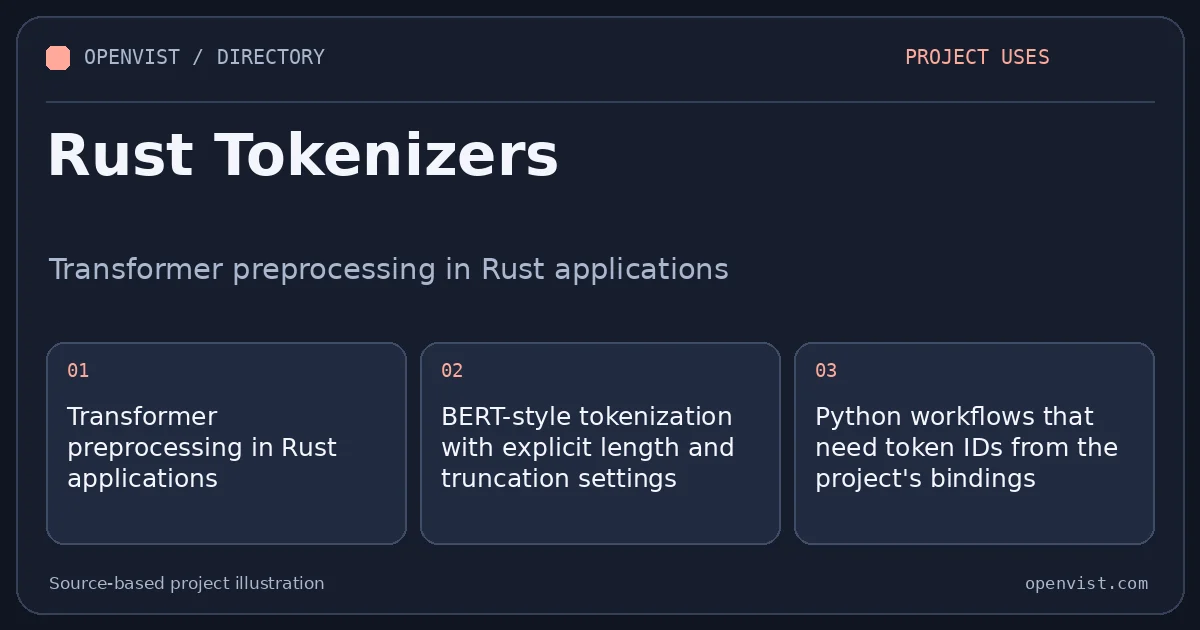
- Rust developers adding tokenizer-based text preprocessing to transformer workflows.
- Python developers who want to use the project's bindings.
- Teams preparing token IDs for a compatible model's inference or classification pipeline.
Documented uses
- Encode input text with a model-appropriate tokenizer.
- Set a maximum input length and a truncation strategy in a tokenization workflow.
- Select a documented WordPiece, BPE or SentencePiece tokenizer for supported model families.
- Use tokenization from Python through bindings built from source.
Before you choose
Requirements & limits
The project is a public GitHub repository identified as Apache-2.0 licensed.
- You must obtain the required vocabulary or merge files manually.
- WordPiece tokenizers support single- and multi-threaded processing; the BPE tokenizers are single-threaded and use a shared cache.
- The documented Python binding build requires the Rust nightly toolchain.
- SentencePiece models use .model protobuf files compatible with the C++ SentencePiece library.
Check current requirements in the official documentation. Source-based guidance does not mean OpenViST has run or independently tested this project.
Source-based practical guide
Build the Python bindings from source
Compile and install the documented Python API.
Before you start
- Rust installed with the nightly toolchain
- The rust-tokenizers repository, including its python-bindings directory
Steps
Install Rust and select the nightly toolchain.
In the python-bindings repository, run the command below.
python setup.py install
Expected outcome
The Rust library is compiled and the Python API is installed.
Guide limitations
- This documents binding setup only, not execution of a Python tokenization workflow.
Evidence and transparency
Sources & review
Source record details
- Source availability
- Active
- Sources checked
- 17 November 2026
- Original website title
- guillaume-be/rust-tokenizers · Official homepage title · retained in its source language