
Understand the project
Practical overview
When it fits
Use ClimateLearn when a climate-modeling experiment needs standardized dataset access and shared benchmarking tools for downscaling or forecasting comparisons.
Who it is for
- Climate researchers comparing machine-learning approaches.
- Developers creating climate-modeling experiments with baseline methods.
- Users analyzing deep-learning robustness and transfer performance on climate tasks.
Documented uses
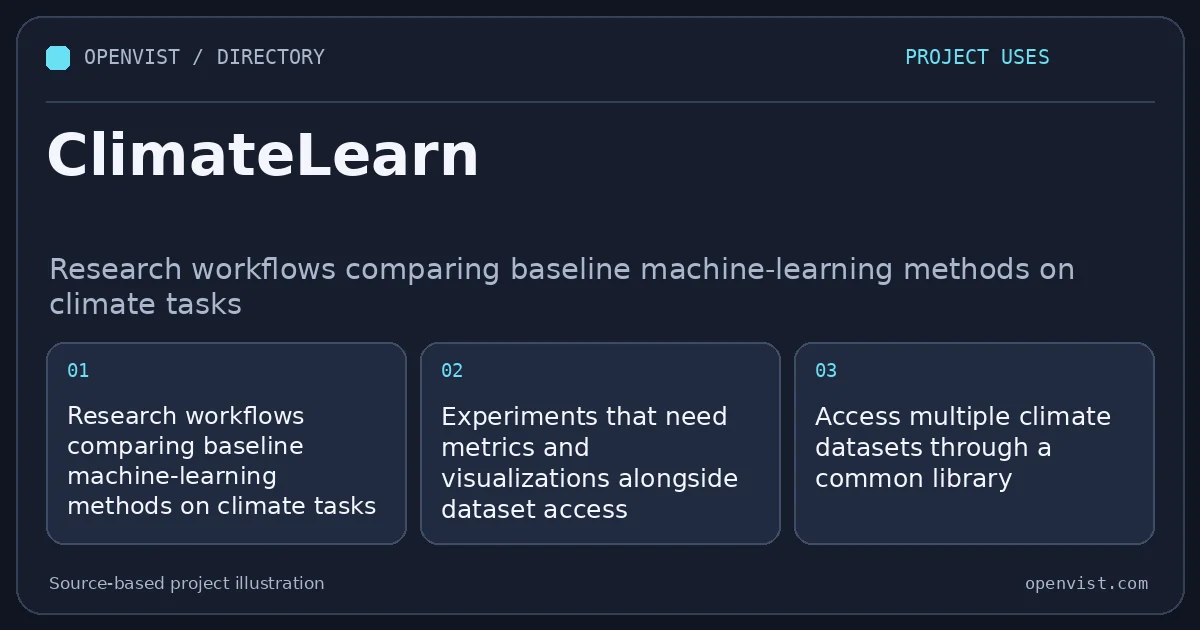
- Access multiple climate datasets through a common library.
- Benchmark statistical downscaling and temporal forecasting methods using baselines, metrics and visualizations.
- Analyze robustness and transfer performance of deep-learning models on climate tasks.
Before you choose
Requirements & limits
The repository is public and lists an MIT license. The quickstart notebook is intended for Google Colab.
- Requires Python 3.8 or later.
- The README specifies installing xESMF separately through Conda before installing the package with pip.
- The quickstart notebook is provided for Google Colab.
Check current requirements in the official documentation. Source-based guidance does not mean OpenViST has run or independently tested this project.
Source-based practical guide
Install ClimateLearn in a Conda environment
Install the documented xESMF dependency and ClimateLearn package.
Before you start
- Python 3.8 or later
- Conda
- pip
Steps
Install xESMF with
conda install -c conda-forge xesmf.Install ClimateLearn with the command below.
pip install climate-learn
Expected outcome
The README’s documented dependency and package installation steps are complete.
Guide limitations
- These installation steps do not describe running a model or benchmark.
Evidence and transparency
Sources & review
Source record details
- Source availability
- Active
- Sources checked
- 16 November 2026
- Original website title
- aditya-grover/climate-learn · Official homepage title · retained in its source language