
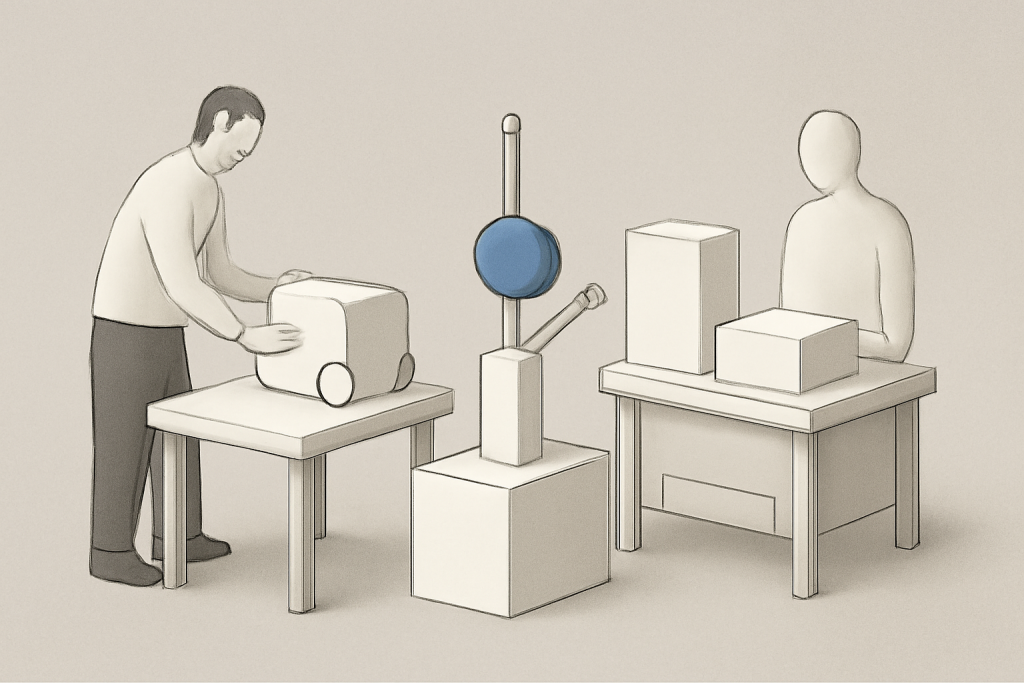
An agent build often starts as one model call with a few tools, then acquires workflow steps, memory, safety checks and a way to supervise runs. The architectural question is not whether to use a framework or a terminal tool. It is which component owns each responsibility, and what must remain stable when another piece changes.
A useful stack separates four concerns: workflow control, persistent context, action boundaries and operator visibility. Those concerns can be implemented by distinct tools, but they are not automatically interchangeable. A memory service cannot replace an execution runtime; a command hook cannot decide whether a multi-step business process is correct. Treat interfaces and failure modes—not labels—as the basis for composition.
Start with responsibilities, not product categories
Draw the path from request to result. A workflow controller decides which step runs next; a model or agent interprets inputs and selects permitted actions; tools perform operations; memory retrieves context; safety controls constrain execution; and an operator observes or intervenes. In a small coding assistant, some of these may live inside one application. In a longer-running process, separating them can make failures easier to contain.
For each component, write down its input, output, state and authority. For example, a memory service might accept a query and return relevant records, while a command guard examines a proposed shell command before it runs. Neither should be granted the authority to redefine the workflow. This simple boundary test exposes misleading substitutions: two tools may both mention “agents” while solving different layers of the build.
Keep workflow control distinct from agent behavior
An agent framework or runtime can coordinate model calls, tools and deterministic steps. Heym, for example, is described as a self-hosted environment for composing and operating agentic systems and deterministic workflows, with execution visibility, retries and approval checkpoints. That makes it relevant when the build needs a controlled run path rather than a collection of disconnected prompts. The Heym listing describes that orchestration scope.
Orchestration is not the same as deciding what an agent should do. A workflow can specify “retrieve a record, draft a change, request approval, then apply it,” while the agent handles interpretation inside a bounded step. Keeping deterministic transitions outside model judgment gives builders a place to enforce required ordering, retry policy and human review.
That distinction also defines a coupling risk. If application logic depends on a particular runtime’s workflow representation, moving to another runtime may require rewriting execution definitions. If the runtime only calls a stable service interface, the model-facing components may be more portable. Before adopting a framework, identify whether your durable business rules live in its workflow format, your own code, or prompts.
Memory is a retrieval service, not a complete state model
Persistent semantic memory answers a particular question: given a query, which stored information is relevant? It does not by itself establish whether a record is current, authoritative or safe to act on. A builder should decide what enters the store, how updates and removals work, and whether a retrieved item is merely context or a source of truth.
Qdrant MCP on Raspberry Pi 5 is described as a JavaScript MCP integration that runs Qdrant locally and gives compatible agents persistent semantic memory and search. Its local, self-hosted design can suit a project that wants an on-device store rather than a hosted memory service. The Qdrant MCP listing is a concrete example of a memory component behind an MCP interface.
That interface can make the memory provider easier to change, but it does not make every memory system equivalent. Embedding choices, data layout, retrieval behavior and operational constraints still affect results. Keep memory access behind a narrow tool boundary, and have the application validate consequential facts against the system that owns them. For instance, a retrieved customer preference may guide a draft, but should not silently replace a current account setting.
Put safety controls at the action boundary
Agent prompts can express intent, but they are not a dependable enforcement point for dangerous operations. A pre-execution guard works closer to the boundary where a proposed action becomes a real shell or Git command. Destructive Command Guard is described as a hook that intercepts and blocks dangerous Git and shell commands for supported AI coding-agent tools. The Destructive Command Guard listing illustrates this narrow protective role.
A command guard complements rather than replaces permissions, sandboxing, backups or review. It can only govern actions that pass through its interception point, and a blocked command does not prove the agent’s broader plan is safe. Builders should test expected blocks and permitted commands, understand how the hook is installed in their chosen tool, and keep credentials and filesystem access limited independently.
This is a good example of a tightly coupled component: the guard must sit in the execution path of the particular command interface it protects. It may be replaceable by another control with the same interception coverage, but not by a memory store or workflow dashboard. Describe controls by what they intercept and what they cannot see, rather than by a general claim of “agent safety.”
Separate runtime execution from operator visibility
Running several coding agents creates a supervision problem: which process is doing what, and where can a person inspect or stop it? Nodeterm is described as a node-based terminal manager that presents real terminals and parallel agent sessions on a canvas, with tmux-backed terminals and a browser Server Edition. The Nodeterm listing places it at the operator-workspace layer, not in the agent’s reasoning or workflow definition.
That distinction matters when selecting substitutes. A terminal dashboard can be replaced by another way to manage processes if it provides the visibility and control the team needs. It does not replace an orchestrator that defines task transitions, nor does a visual session board guarantee that a process has appropriate permissions. Decide whether operators need to inspect live terminals, group work by project, or manage parallel sessions; then choose the lightest tool that covers those needs.
Keep the session manager’s role explicit. It should help people see and control processes, while durable task state and audit-relevant outcomes belong in the application or workflow layer. If a terminal disappears, the build should have a defined way to determine whether work completed, failed or needs recovery.
Draw the replaceable seams—and test them
A component is meaningfully interchangeable when its contract is clear and the surrounding system does not depend on its internal representation. For a memory service, that contract might be “search these approved records and return sources.” For a command control, it might be “allow or deny this proposed command before execution.” For an orchestrator, it might be “run these declared steps with these retry and approval rules.” These contracts are design choices; the listed projects do not imply that they share a common interface with one another.
Test seams with failure cases, not only successful demos. Make memory unavailable and confirm the workflow fails safely or continues without it. Force a tool error and verify that retries do not duplicate an irreversible action. Attempt a prohibited command and confirm the control intercepts it. Stop a session mid-task and check that an operator can distinguish unfinished work from completed work.
Finally, document which state is authoritative and who can initiate each action. A practical first build might use a workflow runtime for explicit steps, an MCP-accessible memory service for retrieval, a pre-execution hook for risky shell commands and a terminal manager for human supervision. Each piece can evolve independently only where its boundary is real; the system still needs deliberate contracts, permissions and recovery behavior to make those seams dependable.