
Understand the project
Practical overview
When it fits
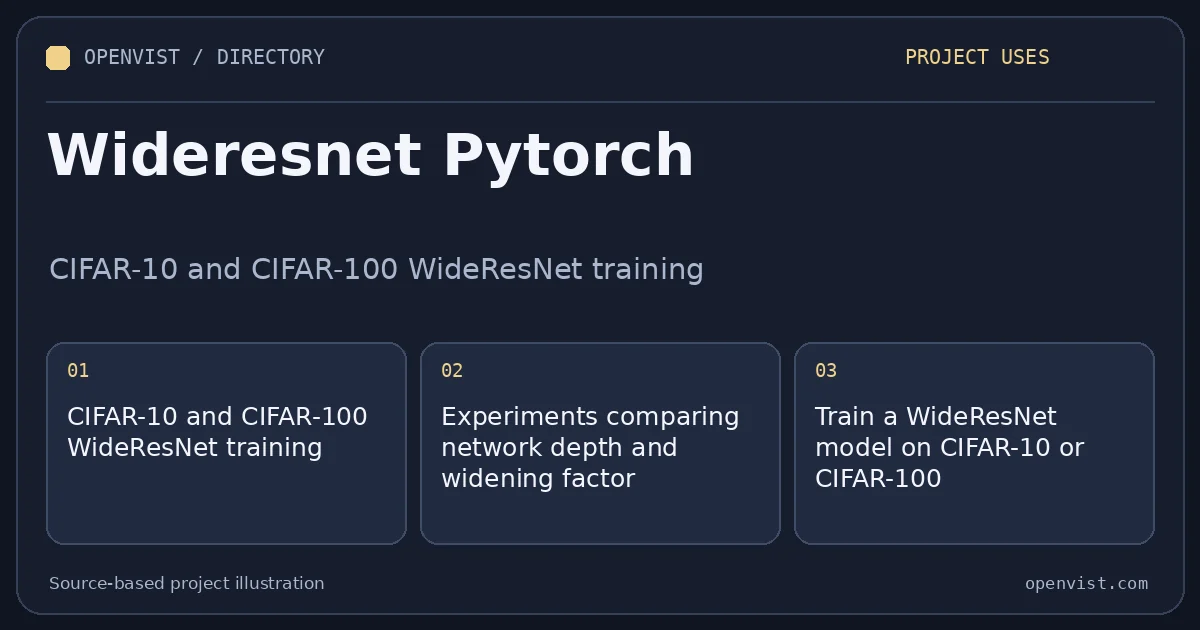
Use the repository when a CIFAR-10 or CIFAR-100 experiment calls for a PyTorch WideResNet implementation and you want to configure depth and widening factor through the training command.
Who it is for
- Researchers and practitioners running CIFAR image-classification experiments with Wide Residual Networks.
- Developers seeking a PyTorch baseline to vary network depth and widening factor.
Documented uses
- Train a WideResNet model on CIFAR-10 or CIFAR-100.
- Use a WideResNet implementation as a baseline for CIFAR classification experiments.
- Compare model configurations by changing depth and widening factor.
Before you choose
Requirements & limits
The repository is public and lists an MIT license.
- The README provides a concrete CIFAR-100 training example using 40 layers and a widening factor of 4.
- The README reports lower GPU memory use than the cited official Torch implementation, but gives no specific hardware requirement.
Check current requirements in the official documentation. Source-based guidance does not mean OpenViST has run or independently tested this project.
Source-based practical guide
Run the documented CIFAR-100 training example
Start training with the repository's README example configuration.
Before you start
- The Wideresnet Pytorch repository
- Python and PyTorch
- The CIFAR-100 dataset
Steps
Obtain the repository's project files.
Prepare the Python and PyTorch environment and make CIFAR-100 available.
Use the README example command: the command below.
python train.py --dataset cifar100 --layers 40 --widen-factor 4
Expected outcome
The example requests training on CIFAR-100 with 40 layers and a widening factor of 4.
Guide limitations
- The example specifies settings but does not report a training result or hardware requirements.
Evidence and transparency
Sources & review
Source record details
- Source availability
- Active
- Sources checked
- 17 November 2026
- Original website title
- xternalz/WideResNet-pytorch · Official homepage title · retained in its source language