
Practical overview
When it fits
Use it when a Go application needs an NLP tokenization stage, especially when the workflow calls for training or fine-tuning supported tokenizer models or loading a compatible pretrained tokenizer file.
Who it is for
- Go developers adding text preprocessing to NLP or machine-learning applications.
- Teams building Go workflows that need to train or fine-tune tokenizers.
- Developers who want to load compatible Hugging Face tokenizer.json files in Go.
Documented uses
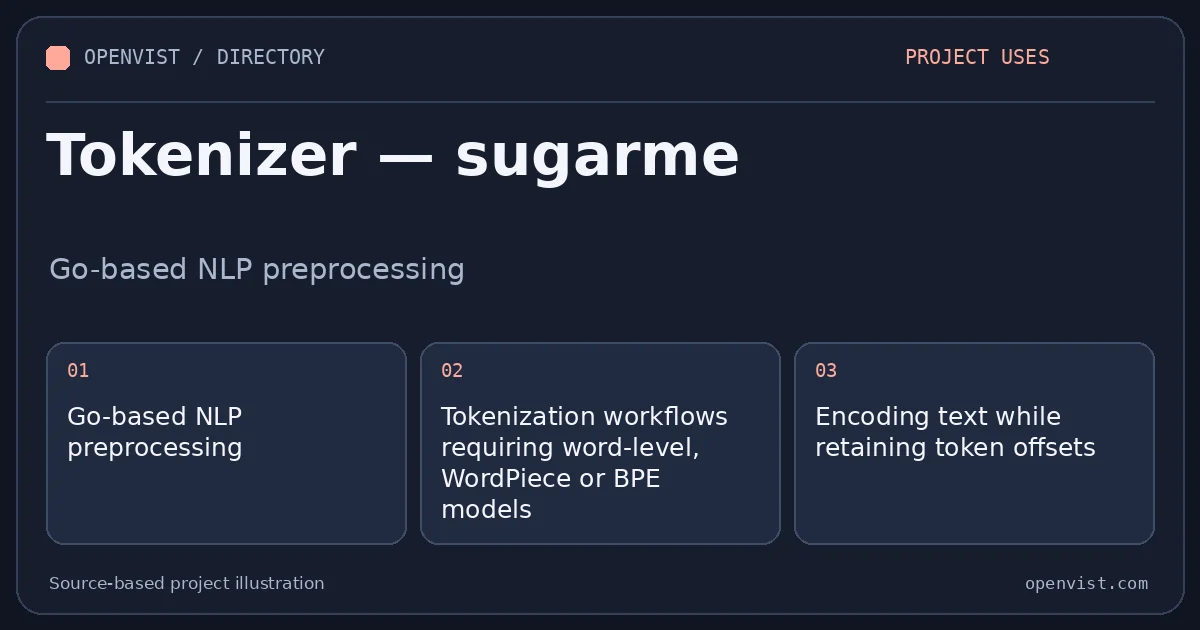
- Normalize and tokenize text before NLP model training, fine-tuning or inference.
- Train a word-level, WordPiece or BPE tokenizer, or fine-tune an existing tokenizer.
- Load a compatible pretrained tokenizer and encode text into tokens with offsets.
Requirements & limits
The repository is public and identifies the project as Apache 2.0 licensed. It links to package API documentation.
- The library is written in Go and is intended for use within Go applications.
- Pretrained loading is available for compatible tokenizer files; the documented example uses tokenizer.json.
- The library supports both tokenizer training and fine-tuning, as well as text encoding.
Check current requirements in the official documentation. Source-based guidance does not mean OpenViST has run or independently tested this project.
Load and use a compatible pretrained tokenizer
Load a compatible Hugging Face tokenizer.json and encode text in a Go application.
Before you start
- A Go application using the sugarme/tokenizer package.
- A compatible pretrained tokenizer.json file; the repository example uses a cached Hugging Face file.
Steps
Retrieve and cache a compatible tokenizer.json using the documented cached-path approach.
Load the file with the pretrained subpackage.
Call the tokenizer's single-text encoding method on a sentence.
Expected outcome
The encoding result contains tokens and their text offsets.
Guide limitations
- Pretrained-file support depends on tokenizer compatibility.
- The repository example documents a cached file path; other tokenizer models can be loaded manually from files.
Sources & review
Source record details
- Source availability
- Active
- Sources checked
- 17 November 2026
- Original website title
- sugarme/tokenizer · Official homepage title · retained in its source language