
Practical overview
When it fits
Use it when you want Theano-based building blocks and documented examples for composing and training sequence models in Python.
Who it is for
- Python developers building sequence-prediction models with Theano.
- Researchers or learners experimenting with recurrent layers, embeddings, and optimization methods.
Documented uses
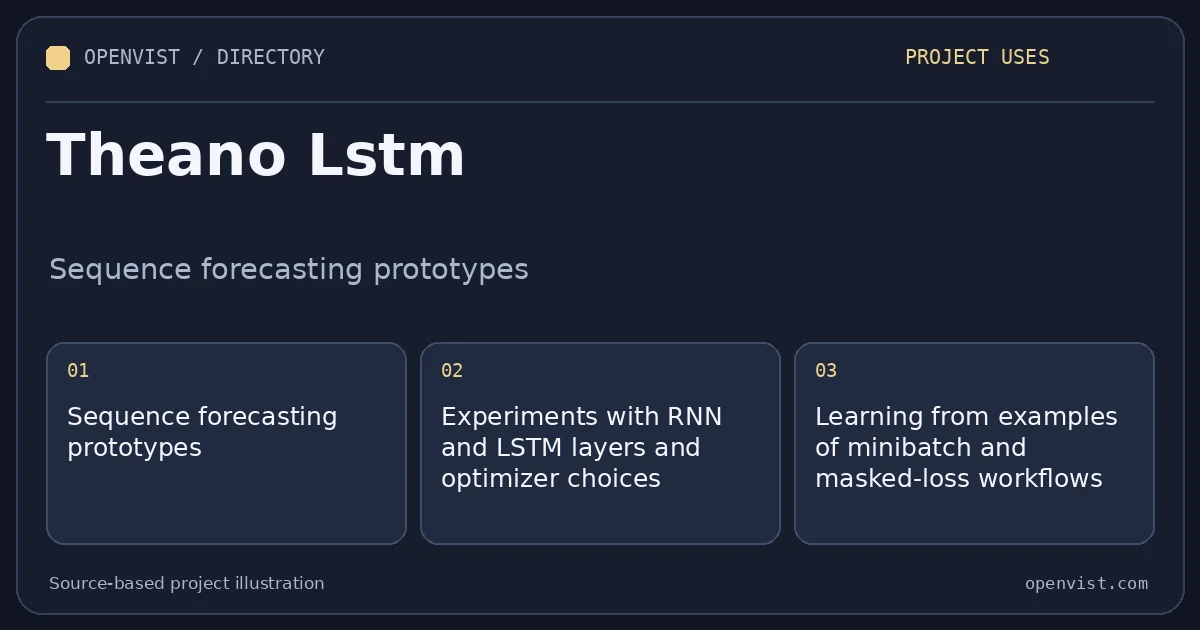
- Assemble recurrent or stacked LSTM models for sequence prediction.
- Use integer inputs with an embedding layer.
- Train models with SGD, AdaGrad or AdaDelta.
- Handle batches of unequal-length sequences using padding and masked loss.
Requirements & limits
- The implementation is a Python module built on Theano, not a hosted model or point-and-click application.
- The README demonstrates Theano symbolic variables, scan operations and compiled functions, so use involves coding model inputs, objectives and training loops.
- Unequal-length batches are handled by padding and masking; the README notes that padding can lead to extra forward computation.
Check current requirements in the official documentation. Source-based guidance does not mean OpenViST has run or independently tested this project.
Build a stacked LSTM sequence model for equal-length sequences
Define a Theano sequence model, its scan-based recurrence, and an Adadelta training function for equal-length examples.
Before you start
- Theano and the module’s model and optimization components, including StackedCells, LSTM, Layer, and create_optimization_updates.
- Sequence examples and labels; the shown single-sequence example passes an initial observation, target, and timestep count.
Steps
Create a StackedCells model with LSTM layers and append an output Layer.
Define a step function that calls the recurrent model’s forward method and returns the next observation and hidden states.
Use theano.scan with the initial observation and hidden states to construct the sequence result, then define a cost from the result and target.
Call create_optimization_updates with the cost, model parameters, and method='adadelta'; compile an update function and call it for each example and label.
Expected outcome
A scan-based sequence model with a compiled training function that updates parameters using Adadelta.
Guide limitations
- The example assumes equal-length sequences and includes a particular target indexing and output setup; adapt these to the task.
- The displayed usage snippet is incomplete in places and does not document environment setup or a complete runnable project.
Prepare variable-length sequences for masked loss
Pad sequences and use a mask-aware loss so errors are calculated only at the intended label positions.
Before you start
- Sequences and labels of different lengths, with their true lengths recorded.
- A prediction sequence and a masked_loss function that accepts predictions, padded labels, codelengths, and label_starts.
Steps
Pad each input sequence to the longest sequence and arrange the padded sequences into a matrix.
Arrange labels at each timestep, using zeros or another symbol in padded label positions.
Record the true label lengths as codelengths and the label positions as label_starts.
Pass predictions, padded labels, codelengths, and label_starts to masked_loss, then take the mean of the resulting error.
Expected outcome
A loss calculation that excludes padded positions and evaluates errors at the specified label positions.
Guide limitations
- The approach may perform unnecessary forward computation over padded parts of sequences.
- The source does not provide a complete implementation of masked_loss or a full runnable example.
Sources & review
Source record details
- Source availability
- Active
- Sources checked
- 20 November 2026
- Original website title
- JonathanRaiman/theano_lstm · Official homepage title · retained in its source language