
Practical overview
When it fits
Use it when you want repository-provided building blocks and scripts for a TensorFlow sequence-to-sequence training and decoding workflow, especially for machine-translation experiments.
Who it is for
- Developers and researchers building recurrent sequence-to-sequence models.
- Practitioners prototyping neural machine translation with paired text.
Documented uses
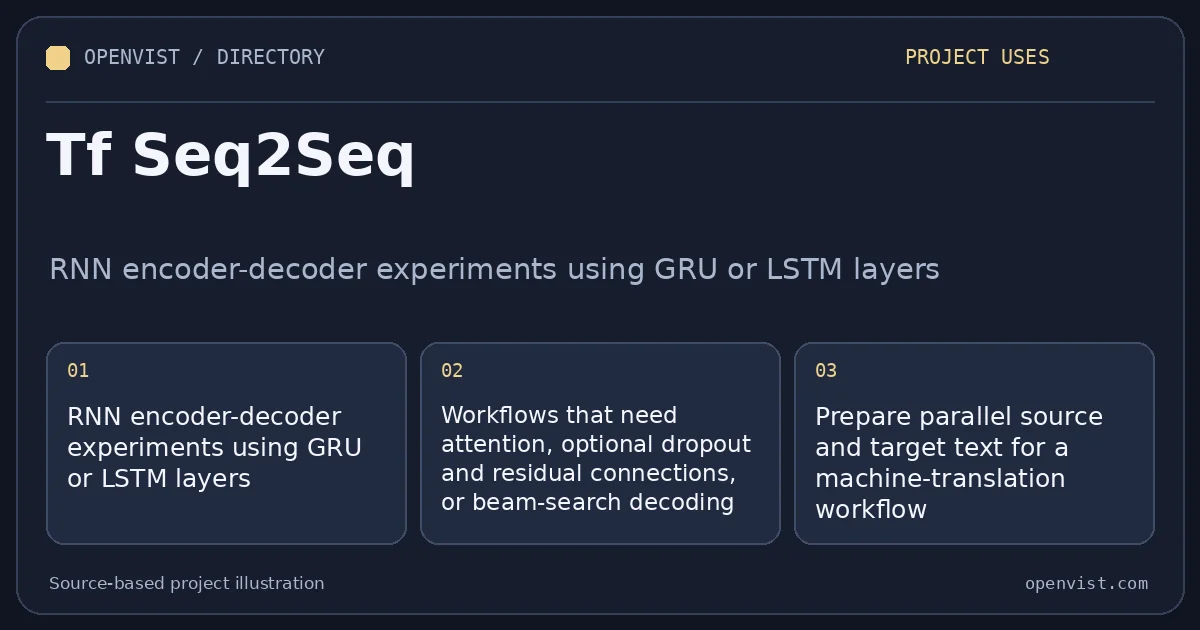
- Prepare parallel source and target text for a machine-translation workflow.
- Train a multi-layer GRU or LSTM encoder-decoder with attention.
- Decode text with greedy or beam-search methods and optionally write an n-best list.
Requirements & limits
- The listed dependencies are NumPy 1.11.1 or later and TensorFlow 1.2 or later.
- The implementation uses TensorFlow 1.x contrib.seq2seq modules, so its stated stack is important when assessing a development environment.
- The repository separates preprocessing, training and decoding; decoding requires a trained checkpoint.
Check current requirements in the official documentation. Source-based guidance does not mean OpenViST has run or independently tested this project.
Preprocess paired text for machine translation
Prepare source and target text files using the repository's documented preprocessing script.
Before you start
- Raw parallel source and target data files.
- NumPy 1.11.1 or later and TensorFlow 1.2 or later are listed as package dependencies.
Steps
Change to the repository's data directory.
Run
./preprocess.sh src trg sample_data ${max_seq_len}, substituting the chosen maximum sequence length.
Expected outcome
The script normalizes punctuation, tokenizes, applies byte-pair encoding, filters sequences above the length limit, shuffles the data and builds dictionaries.
Guide limitations
- The guide covers data preparation only; training and decoding are separate stages.
- The README describes preprocessing for machine translation.
Train and decode a sequence-to-sequence model
Use the documented training and decoding scripts with prepared data and a model checkpoint.
Before you start
- Prepared source and target training data and vocabularies; validation data is needed when evaluating on validation data.
- NumPy 1.11.1 or later and TensorFlow 1.2 or later.
- A trained model checkpoint and decode input for the decoding stage.
Steps
Configure
train.pywith model options such as cell type, attention type, depth, embedding size and vocabulary sizes.Train using the repository's training script and save checkpoints to the configured model directory.
Run
decode.pywith the checkpoint path, decode input and output paths, and a beam width.Set beam width to 1 for greedy decoding, or enable n-best output for beam-search candidates.
Expected outcome
The workflow trains a recurrent encoder-decoder model and writes decoded output; beam search can also write an n-best list.
Guide limitations
- The README gives example command arguments but does not provide a complete dataset-specific configuration.
- The documented implementation depends on TensorFlow 1.x contrib.seq2seq components.
Sources & review
Source record details
- Source availability
- Active
- Sources checked
- 16 November 2026
- Original website title
- jayparks/tf-seq2seq · Official homepage title · retained in its source language