
Understand the project
Practical overview
When it fits
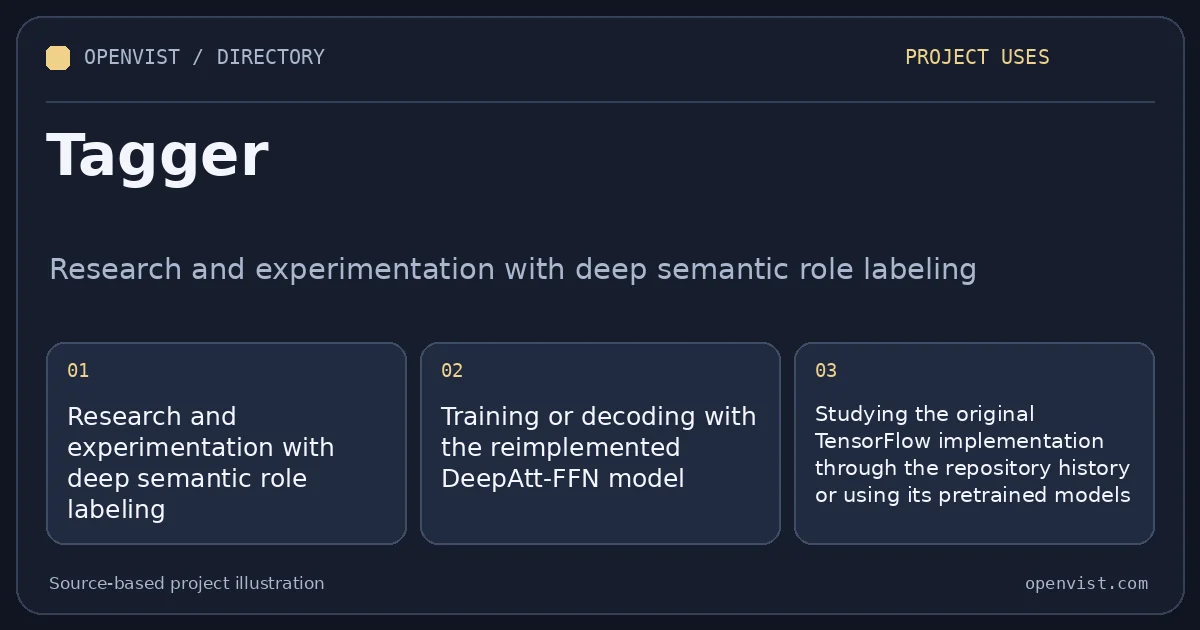
Use Tagger when you have the data and dependencies needed to run a research workflow for semantic role labeling, or when you want to examine the project’s reported CoNLL-2005 experiments.
Who it is for
- Researchers studying semantic role labeling and self-attention models.
- Developers building text-processing experiments that need semantic-role annotations.
Documented uses
- Generate word and label vocabularies from processed training data.
- Train a DeepAtt-FFN semantic role labeling model.
- Decode predictions for prepared input text using a trained model.
- Use available TensorFlow pretrained models as a starting point for semantic role labeling.
Before you choose
Requirements & limits
The public repository is licensed under BSD-3-Clause.
- The current reimplementation uses PyTorch and implements only DeepAtt-FFN; model ensembles are unavailable.
- The README lists Python 3, PyTorch, TensorFlow 2.0 CPU, GloVe embeddings, and
srlconllscripts as prerequisites. - CoNLL datasets are not provided, and the README refers users to
deep_srlfor data conversion procedures and related resources. - Pretrained models are for the TensorFlow implementation; the README describes the original code as TensorFlow 1.0 and directs users to Git history for it.
Check current requirements in the official documentation. Source-based guidance does not mean OpenViST has run or independently tested this project.
Source-based practical guide
Build vocabularies from prepared training data
Generate the word and label vocabulary files used in Tagger's training workflow.
Before you start
- Python 3
- Tagger repository
- A processed training-data file in the expected format
- A chosen vocabulary-size limit
Steps
Run the command below, replacing the placeholders with the vocabulary limit, training file, and output directory.
python tagger/scripts/build_vocab.py --limit LIMIT --lower TRAIN_FILE OUTPUT_DIRUse the generated
vocab.txtandlabel.txtfiles in the subsequent model workflow.
Expected outcome
The output directory contains the word and label vocabulary files.
Guide limitations
- This covers vocabulary generation only, not model training or prediction.
- The README says CoNLL datasets are not provided; data preparation follows procedures in the linked deep_srl repository.
Evidence and transparency
Sources & review
Source record details
- Source availability
- Active
- Sources checked
- 20 November 2026
- Original website title
- XMUNLP/Tagger · Official homepage title · retained in its source language