
Practical overview
When it fits
Use it when you need a code-based speech-separation workflow or want to study and adapt the project’s training setup; it is not presented as a hosted audio editing service.
Who it is for
- Audio-processing researchers exploring speech separation models.
- Developers who want to synthesize separated audio or train a separation model with the repository’s workflows.
Documented uses
- Separate speech from a single recording or process files in a directory.
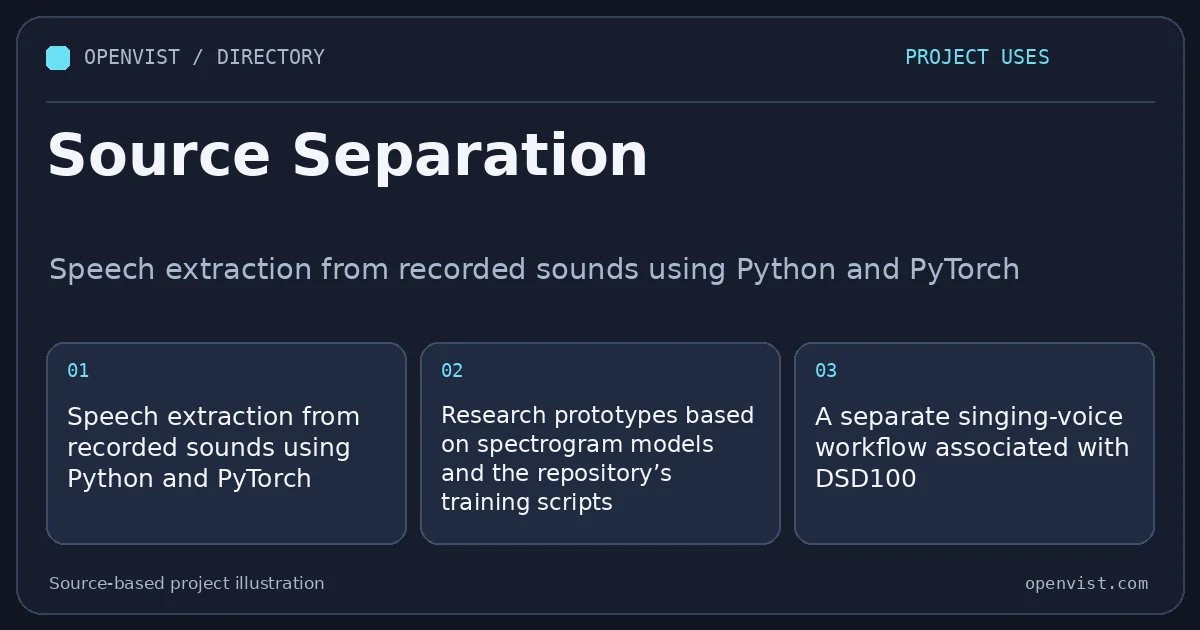
- Train a general voice-separation model or jointly train with Voice Bank and DSD100 metadata.
- Explore a Colab notebook demonstration of synthesis.
Requirements & limits
The repository is public and identified as open source under the Apache-2.0 license. The README links a Colab notebook and pretrained checkpoints.
- The README lists Python above 3.6, PyTorch 1.0 and Ubuntu 16.04; these are documented environment details, not a compatibility guarantee.
- The project depends on separate pytorch_sound and audioset_augmentor repositories; python-pesq is listed for evaluation code.
- The README distinguishes general voice and singing-voice sample rates and provides separate model checkpoints.
- Training requires metadata and dataset preparation, with setup guidance referenced in the external repositories.
- The README’s cited cluster configuration is its project environment, not a universal runtime requirement.
Check current requirements in the official documentation. Source-based guidance does not mean OpenViST has run or independently tested this project.
Synthesize separated audio from one recording
Use a pretrained checkpoint with the repository’s single-file synthesis command.
Before you start
- The Source Separation repository and its documented external dependencies: audioset_augmentor, pytorch_sound and python-pesq for evaluation code.
- An input audio file, output path, model name and pretrained checkpoint path.
- Python above 3.6, PyTorch 1.0 and Ubuntu 16.04 are listed in the README environment section.
Steps
Install the listed external repositories using the README’s pip commands.
Install the repository package with the command below.
pip install -e .Run the command below, substituting the input, output, model and checkpoint values.
python source_separation/synthesize.py separate [INPUT_PATH] [OUTPUT_PATH] [MODEL NAME] [PRETRAINED_PATH] [OTHER OPTIONS...]
Expected outcome
The command is documented to synthesize a separated output for one input recording.
Guide limitations
- The README warns that general voice and singing-voice cases have different sample rates.
- The command’s optional arguments and runtime resource needs are not fully detailed in the cited usage instructions.
Sources & review
Source record details
- Source availability
- Active
- Sources checked
- 20 November 2026
- Original website title
- AppleHolic/source_separation · Official homepage title · retained in its source language