
Understand the project
Practical overview
When it fits
Use it when you need Python/PyTorch code and example scripts for training or inference with sequence-generation models, and can prepare the data and configure the run yourself.
Who it is for
- Developers and researchers experimenting with neural machine translation or language models.
- Practitioners building image-captioning models or sentence representations.
- PyTorch users who want configurable recurrent, attention-based or Transformer sequence models.
Documented uses
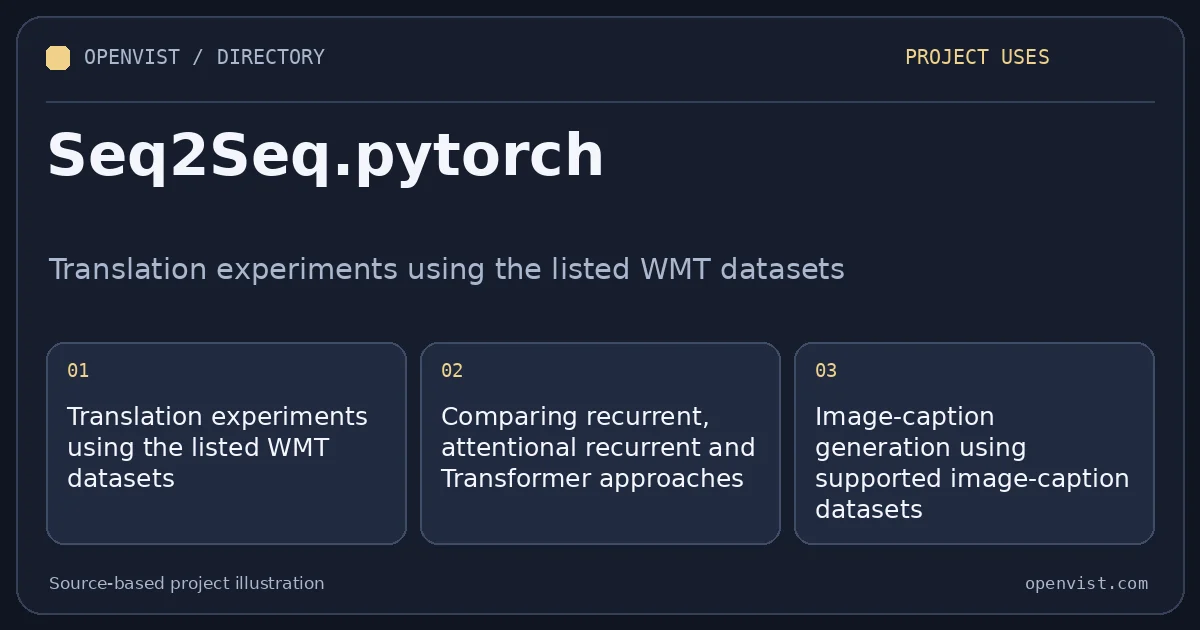
- Train sequence-to-sequence models for machine translation or language modeling.
- Train image-to-caption models using the Image2Seq method.
- Run inference examples with trained models.
- Experiment with character, word or BPE tokenization and generated vocabularies.
Before you choose
Requirements & limits
The public repository is open source under the MIT license.
- The repository includes multiple model families, including simple recurrent, attentional recurrent, GNMT-style recurrent and Transformer models.
- Supported tokenization choices are character-based, word-based and byte-pair encoding; a vocabulary is generated and saved for inference.
- Training and inference are separate documented stages, with scripts in
scriptsand examples inexamples.
Check current requirements in the official documentation. Source-based guidance does not mean OpenViST has run or independently tested this project.
Source-based practical guide
Install the repository for local use
Clone the project with its submodules and install it in develop mode.
Before you start
- Python environment
- PyTorch
Steps
Clone the repository recursively with the command below.
git clone --recursive https://github.com/eladhoffer/seq2seq.pytorchChange into the
seq2seq.pytorchdirectory.Run the command below.
python setup.py develop
Expected outcome
The project is installed in develop mode in the current Python environment.
Guide limitations
- The documented installation steps do not cover dataset preparation, model training or inference.
Evidence and transparency
Sources & review
Source record details
- Source availability
- Active
- Sources checked
- 11 November 2026
- Original website title
- eladhoffer/seq2seq.pytorch · Official homepage title · retained in its source language