
Practical overview
When it fits
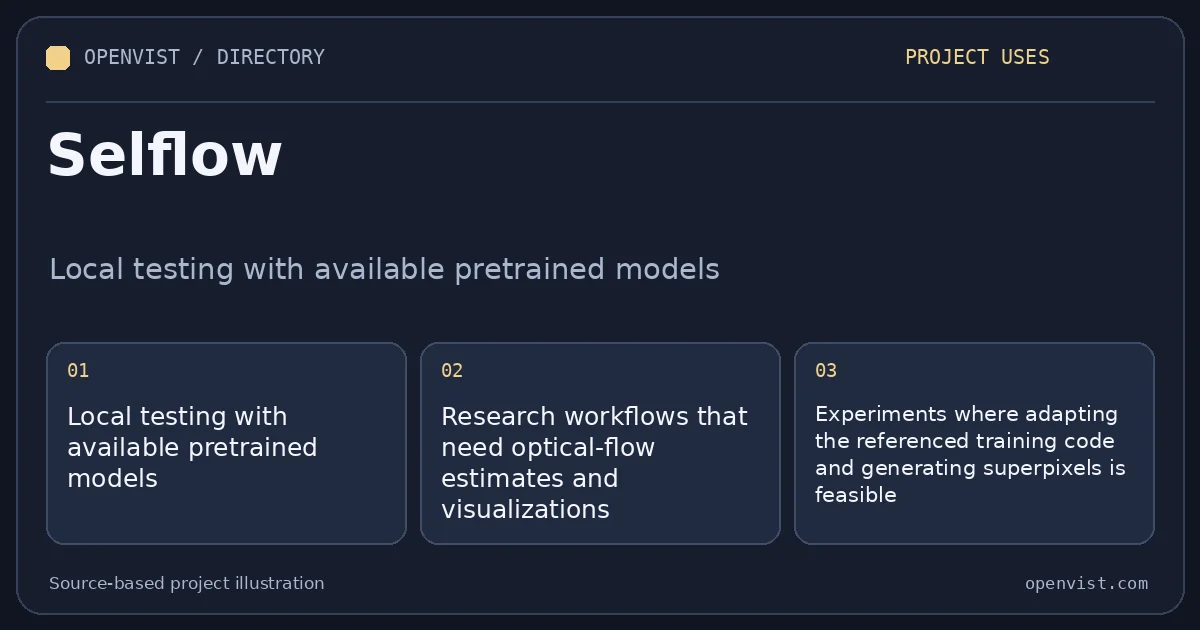
Use SelFlow when you need a research codebase for optical-flow experiments and can configure a local Python environment, image inputs and model settings.
Who it is for
- Computer-vision researchers evaluating optical-flow models on image sequences.
- Developers experimenting with self-supervised motion estimation or adapting an optical-flow research baseline.
Documented uses
- Estimate forward and backward motion between frames.
- Generate visualizations of optical-flow results.
- Evaluate available pretrained models on Sintel or custom image sequences.
- Prepare a research training workflow using the referenced DDFlow code and a superpixel-generation script.
Requirements & limits
The repository is public and licensed under MIT. It documents local Python use and includes a Dockerfile; no hosted inference service is described.
- The documented stack specifies Python 2 or 3, OpenCV and TensorFlow 1.8; other TensorFlow versions may require code changes.
- Pretrained model availability is partial, rather than a complete set.
- Training requires referring to DDFlow and adding a superpixel-generation script.
- The README's Sintel benchmark result is explicitly historical, covering November 2018 to November 2019.
Check current requirements in the official documentation. Source-based guidance does not mean OpenViST has run or independently tested this project.
Test a pretrained model on an image sequence
Configure SelFlow to produce forward and backward optical-flow outputs and visualizations for local images.
Before you start
- Python 2 or Python 3, OpenCV and TensorFlow 1.8; Anaconda is optional.
- A local image directory and a pretrained model.
- A data-list file whose first three columns contain input image names and whose last column contains the saving name.
Steps
Edit the configuration file and set mode to test.
Set data_list_file to the data-list file and img_dir to the image directory.
Set is_normalize_img=True for a supervised pretrained model, or False for an unsupervised pretrained model.
Run python main.py.
Expected outcome
SelFlow writes forward and backward optical flow and their visualizations to the output folder.
Guide limitations
- The repository provides testing code and only part of its pretrained models.
- The README notes that TensorFlow versions other than 1.8 may require function changes.
Sources & review
Source record details
- Source availability
- Active
- Sources checked
- 15 November 2026
- Original website title
- ppliuboy/SelFlow · Official homepage title · retained in its source language