
Practical overview
When it fits
Use it to explore or develop experimental LLM-assisted security workflows, particularly when you can assess and contribute to a project whose plugins are still in development.
Who it is for
- Developers exploring plugin-based LLM workflows for network security.
- Contributors interested in extending an experimental security-tool project.
Documented uses
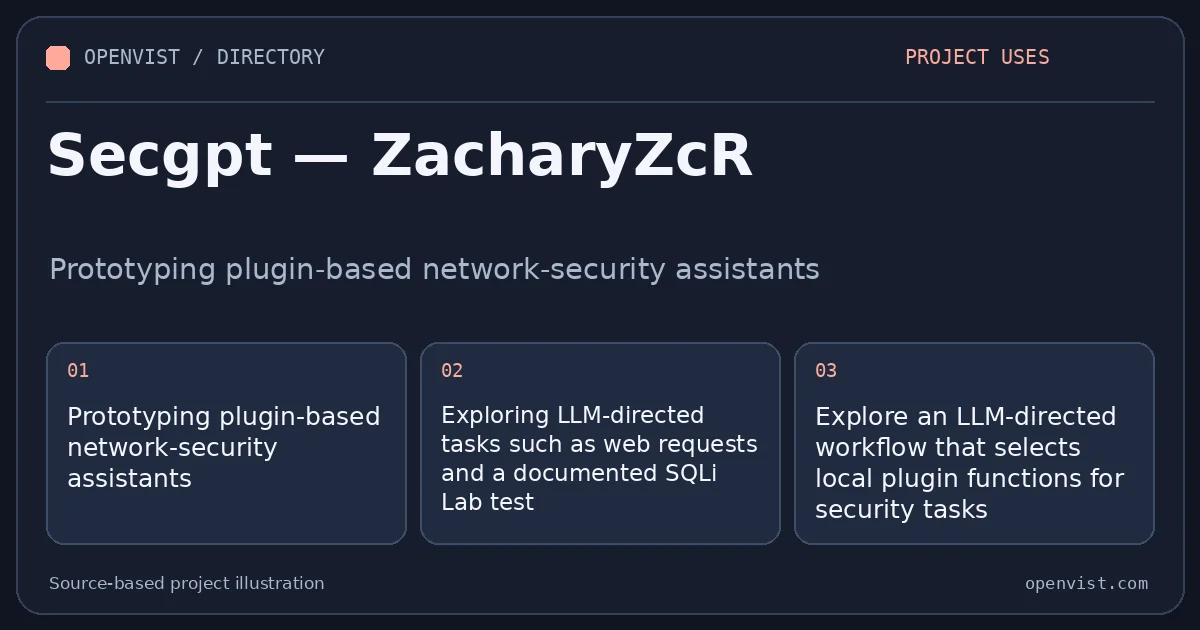
- Explore an LLM-directed workflow that selects local plugin functions for security tasks.
- Use example plugins for web requests, file operations and a sqlmap-based test.
- Investigate possible workflows for vulnerability scanning, code review and report writing.
Requirements & limits
The README identifies an OpenAI API key as a requirement. It presents installation and startup commands as examples rather than a complete setup guide.
- The project is explicitly experimental, and its README says plugins are still being written and tested.
- The documented examples include web requests, file operations and a sqlmap test; broader security tasks are described as aims.
- The project uses Python and is inspired by AutoGPT; its documentation also references LangChain.
- The repository lists the Apache-2.0 license.
Check current requirements in the official documentation. Source-based guidance does not mean OpenViST has run or independently tested this project.
Install and start SecGPT
Clone the project, install its listed dependencies, run the environment check, then start SecGPT and create a role on first launch.
Before you start
- Python and pip are available.
- An OpenAI API key is required.
Steps
Clone the repository with the command below.
git clone https://github.com/ZacharyZcR/SecGPT.gitInstall dependencies with the command below.
pip install -r requirements.txtRun the command below to check whether the environment can run normally.
python install.pyRun the command below to start the program; create a new role when starting for the first time.
python SecGPT.py
Expected outcome
SecGPT starts after the environment check, and a new role is created on first launch.
Guide limitations
- The project is marked experimental, and the author does not guarantee full code quality.
- Plugins are still being written and tested; the README says the project needs more technical support.
Sources & review
Source record details
- Source availability
- Active
- Sources checked
- 21 November 2026
- Original website title
- ZacharyZcR/SecGPT · Official homepage title · retained in its source language