
Practical overview
When it fits
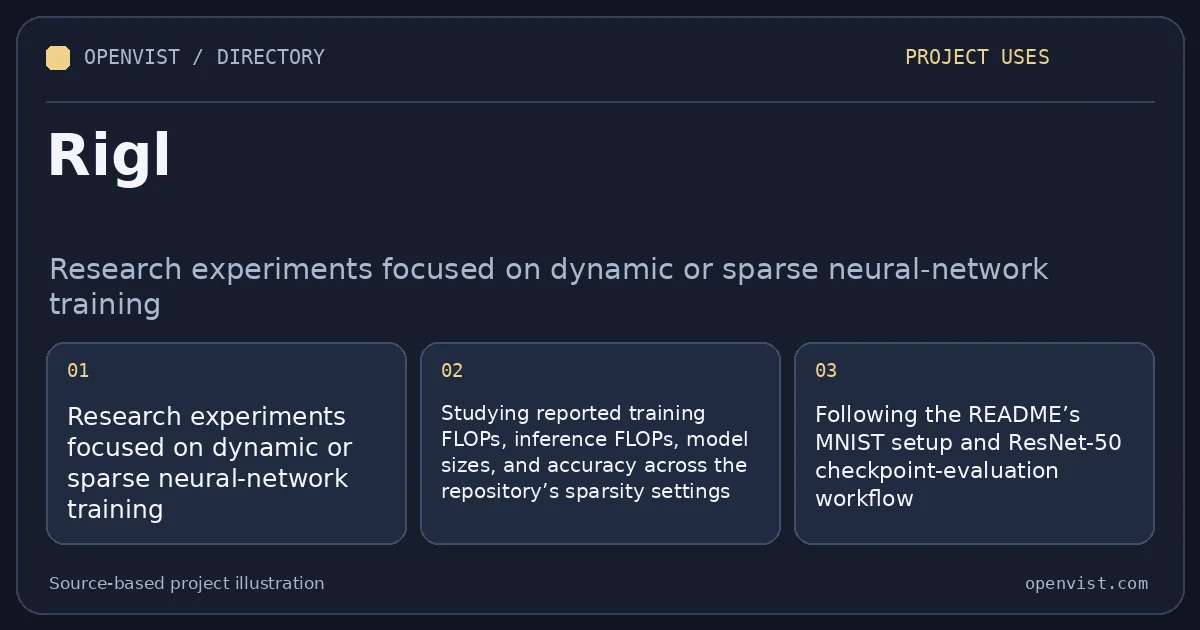
Use Rigl when you need research code and documented examples for sparse neural-network training, or want to examine sparse-model FLOPs for the listed architectures.
Who it is for
- Researchers studying sparse deep neural-network training.
- Machine-learning practitioners reproducing RigL experiments or examining sparse-model compute.
Documented uses
- Experiment with sparse deep neural-network training.
- Reproduce the Rigging the Lottery research approach.
- Calculate FLOPs for sparse MobileNet-v1 and ResNet-50 models.
- Prepare a documented MNIST example or evaluate a ResNet-50 checkpoint.
Requirements & limits
The repository is public on GitHub and licensed under Apache-2.0.
- The documented setup uses Git, a Python virtual environment, and PYTHONPATH changes; ResNet-50 evaluation adds the TensorFlow TPU models directory.
- The README includes separate MobileNet-v1 and ResNet-50 FLOPs-counting notebooks.
- Reported results vary by sparsity distribution and training length, so tables should be interpreted as experiment-specific results.
Check current requirements in the official documentation. Source-based guidance does not mean OpenViST has run or independently tested this project.
Set up Rigl and run the MNIST example
Prepare the repository environment and run the README’s documented MNIST training-and-evaluation example.
Before you start
- Git
- Python environment suitable for the repository’s dependencies
- A shell for the documented commands
Steps
Clone https://github.com/google-research/rigl.git and enter the rigl directory.
Clone https://github.com/google-research/google-research.git, rename the resulting directory to google_research/, and add the current folder to PYTHONPATH.
Run bash run.sh to create a virtual environment and install necessary libraries.
Activate the environment with source env/bin/activate, then run python rigl/mnist/mnist_train_eval.py.
Expected outcome
The README’s MNIST training-and-evaluation script is run from the prepared environment.
Guide limitations
- The documented setup command runs tests as well as creating the environment; this guide does not claim those commands have been executed or verified.
Prepare the documented ResNet-50 checkpoint evaluation
Set up the additional repository path required by Rigl’s documented ResNet-50 evaluation command.
Before you start
- The Rigl repository and its setup environment
- The TensorFlow TPU repository
- A ResNet-50 checkpoint and an output directory for evaluation
Steps
Clone https://github.com/tensorflow/tpu.git.
Add the cloned repository’s models/ directory to PYTHONPATH.
Use the README’s imagenet_train_eval.py command with --mode=eval_once, the baseline training method, an evaluation batch size, an output directory, and the checkpoint prefix.
Expected outcome
The documented command is configured to evaluate a ResNet-50 checkpoint once.
Guide limitations
- The README’s example uses specific flags and a checkpoint prefix; it does not provide the checkpoint in the setup instructions.
Sources & review
Source record details
- Source availability
- Active
- Sources checked
- 17 November 2026
- Original website title
- google-research/rigl · Official homepage title · retained in its source language