
Practical overview
When it fits
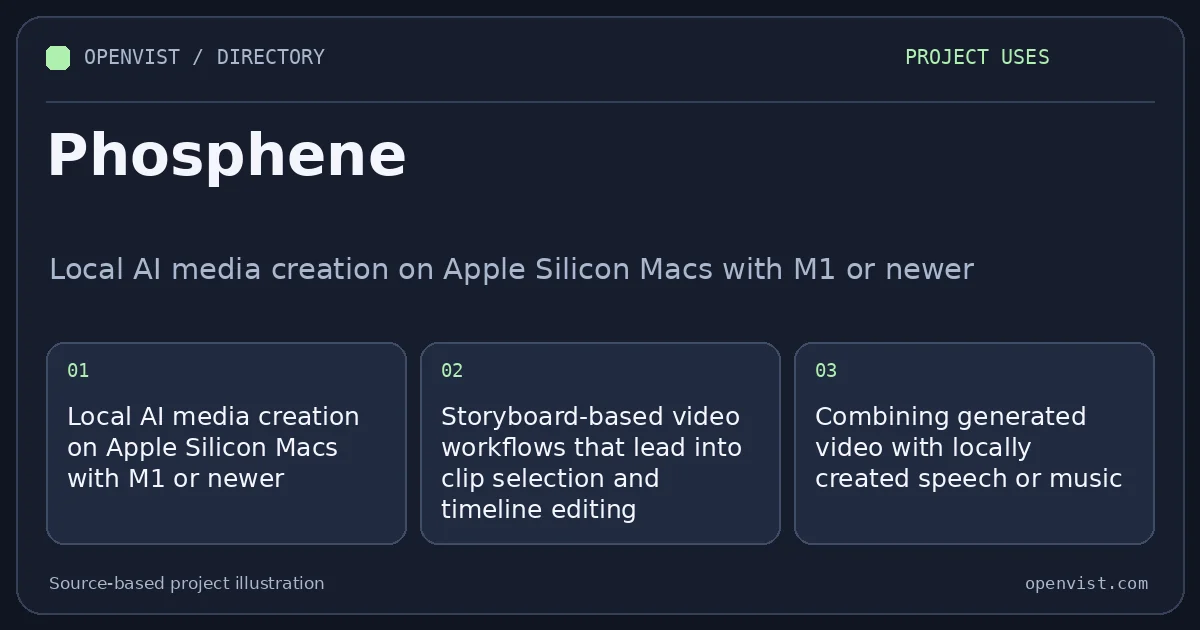
Use Phosphene when you want a local Mac workflow for generating AI media and editing the resulting video clips, or when you need its documented agent tools to submit jobs to a running studio.
Who it is for
- Mac users who want to generate AI media locally rather than use a hosted generation service.
- Video makers who want to plan a film as storyboard shots and edit selected clips on a timeline.
- Users who want to generate speech or songs alongside visual media.
- Developers and agent users seeking documented CLI or MCP access to a running local studio.
Documented uses
- Describe and queue video shots for local generation.
- Plan a film through a storyboard, render its shots and move selected clips to the editor.
- Trim, split and arrange generated clips on a timeline.
- Generate images, spoken WAV files, or songs with vocals and instruments.
- Submit generation jobs and retrieve their outputs through documented agent tools.
Requirements & limits
The documented supported platform is macOS on Apple Silicon, installed through Pinokio. Phosphene has a free edition and an optional paid Pro tier. Linux is described as a community-maintained target, not the supported platform.
- Generation is performed locally, and the documentation says the service does not host generation.
- The documented Mac installation route is through Pinokio and requires an Apple Silicon Mac with M1 or newer.
- The built-in editor supports trimming, splitting and arranging clips, while storyboard workflows can pass selected shots into the editor.
- Agent access requires the local studio to be running; documented options include a Python CLI and MCP tools.
- Model-licence acceptance is a user action in the app, not an agent-tool action.
Check current requirements in the official documentation. Source-based guidance does not mean OpenViST has run or independently tested this project.
Connect an agent to the running Phosphene studio
Set up the documented agent connection so an MCP client can use Phosphene's local generation tools.
Before you start
- Phosphene installed and running on a Mac; the documented connection flow requires Mac app version 5.0.9 or later.
- Claude Code, Codex or another MCP client.
Steps
Open Phosphene and choose Help → Connect an agent.
Select Claude Code, Codex or the relevant desktop client.
Copy the command or configuration supplied for that installation into the client.
Keep Phosphene open while the agent works.
Expected outcome
The client is configured to use Phosphene's local studio and its documented video, image, speech and music tools.
Guide limitations
- Generation tools queue jobs; renders can take minutes.
- Model-licence acceptance must be completed by the person in Phosphene, not by an agent tool.
- If an update changes installation paths, copy a fresh connection from the same Help menu.
Sources & review
Source record details
- Source availability
- Active
- Sources checked
- 15 November 2026
- Original website title
- Phosphene · Free AI video with sound, on your Mac. Offline. · Official homepage title · retained in its source language