
Practical overview
When it fits
Use Numalogic when you want Python building blocks for operational time-series modeling, anomaly scoring, or experimentation with synthetic anomalies; pair it with Numaflow when the workflow needs streaming data processing.
Who it is for
- Data and ML practitioners working with operational time-series data.
- Engineering teams exploring anomaly detection or streaming ML pipelines.
Documented uses
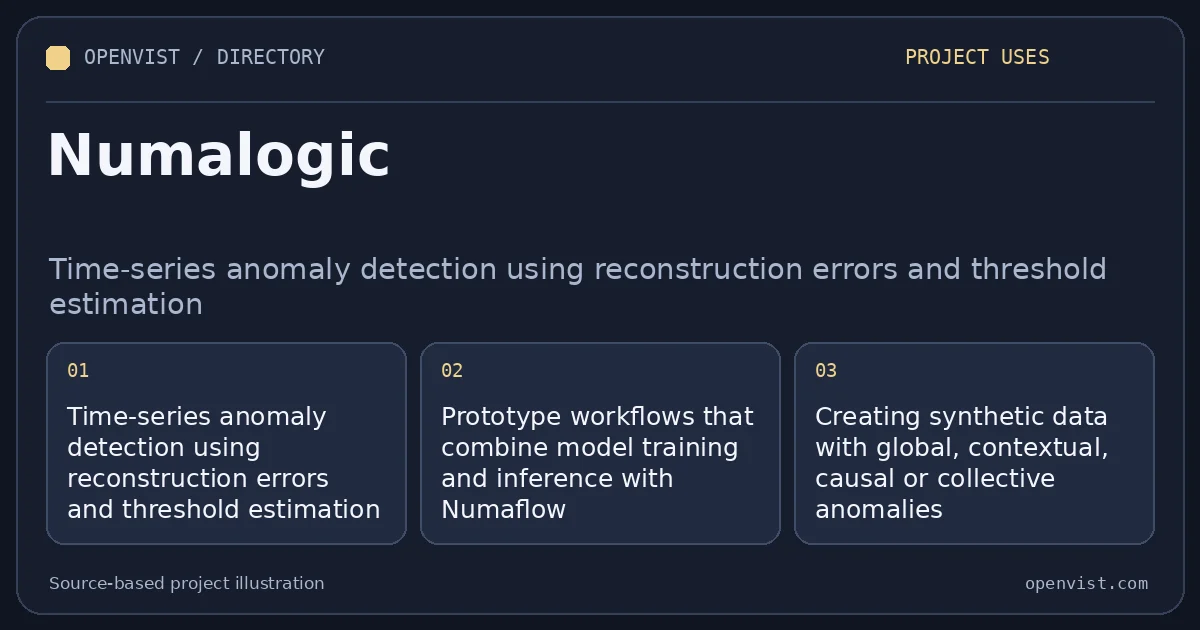
- Train a time-series autoencoder and score test sequences for anomalies.
- Build streaming workflows that preprocess data, train models and return anomaly scores.
- Generate synthetic time series and inject labeled anomaly patterns for experimentation.
Requirements & limits
- The library workflow requires PyTorch and PyTorch Lightning; the quick start also uses NumPy, scikit-learn and PyTorch data utilities.
- The documented streaming path requires Numaflow and shows Kubernetes-based pipeline operations.
- The quick-start model uses sequence windows, so sequence length is an explicit modeling choice.
- The synthetic-data tools support both multivariate series generation and configurable anomaly injection.
Check current requirements in the official documentation. Source-based guidance does not mean OpenViST has run or independently tested this project.
Train and score a time-series anomaly model
Use the documented library workflow to train an autoencoder and calculate anomaly scores for test data.
Before you start
- Install Numalogic and PyTorch Lightning with pip; install a platform-specific PyTorch version as needed.
- Use Python with NumPy, scikit-learn, PyTorch data utilities, and Numalogic.
Steps
Scale training and test data with StandardScaler.
Create a StreamingDataset with a sequence length and define a VanillaAE model.
Fit TimeseriesTrainer using a DataLoader, then predict reconstruction errors for the training data.
Fit StdDevThreshold on training reconstruction errors and score the test reconstruction errors; optionally normalize scores with TanhNorm.
Expected outcome
Anomaly scores for the test sequences, with the example showing larger scores for unusual values.
Guide limitations
- The documented example uses synthetic, single-feature data and a particular autoencoder and threshold estimator; it does not establish suitability for other datasets or production workloads.
Explore synthetic time series and injected anomalies
Generate synthetic series, split them into training and test sets, and inject a documented anomaly type into selected test columns.
Before you start
- A Python environment with Numalogic installed.
Steps
Create a SyntheticTSGenerator with a sequence length, series count, frequency and other desired generator parameters.
Generate a time-series dataframe and split it into training and test data.
Create an AnomalyGenerator using the training data and a supported anomaly type.
Inject anomalies into selected test columns, setting the desired anomaly ratio and impact.
Expected outcome
Synthetic training and test data with injected anomalies for model or algorithm experiments.
Guide limitations
- The guide documents synthetic-data generation and anomaly injection, not model training or evaluation results.
Sources & review
Source record details
- Source availability
- Active
- Sources checked
- 21 November 2026
- Original website title
- Numalogic - Collection of operational time series ML models and tools · Official homepage title · retained in its source language