
Practical overview
When it fits
Use it when dataset preparation calls for configurable processing stages and distributed execution, particularly for large collections intended for foundation-model development.
Who it is for
- Developers building repeatable data-curation pipelines for foundation-model training.
- Research and engineering teams processing large text or image datasets.
Documented uses
- Load and shard Hugging Face datasets or process Common Crawl WARC files.
- Filter text using URL, length, language, repetition and other quality heuristics.
- Normalize text and remove exact duplicates.
- Build image data workflows with documented quality-filtering and deduplication stages.
Requirements & limits
The repository is public and lists an MIT license. Installation instructions document a Rust-accelerated path and a pure-Python fallback; Rust is required to build accelerated operators.
- Ray is the documented distributed-processing foundation.
- Rust acceleration is optional at installation, but a Rust toolchain is required to build accelerated operators.
- The README marks some pipeline implementations as in progress or planned, so check each workflow's stated status before selecting it.
- The documented text operators include exact deduplication; the README lists MinHash deduplication as coming soon.
Check current requirements in the official documentation. Source-based guidance does not mean OpenViST has run or independently tested this project.
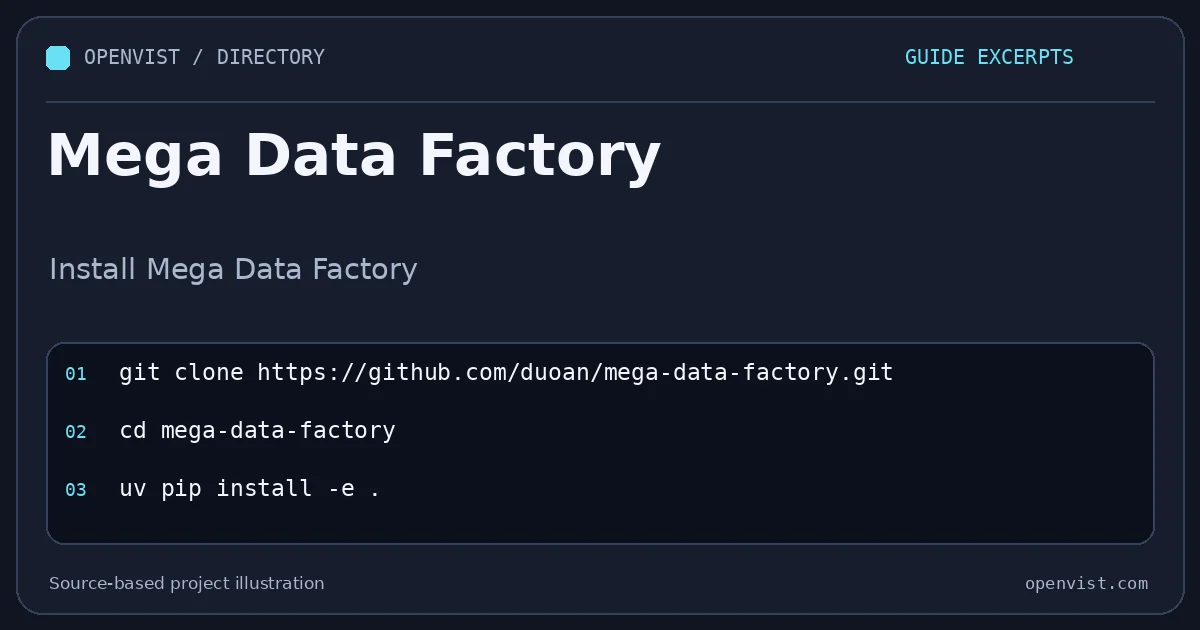
Install Mega Data Factory
Set up the repository with either Rust-accelerated operators or the pure-Python installation path.
Before you start
- A Python environment with
uvavailable. - For accelerated operators, a Rust toolchain installed through rustup.
Steps
Clone the repository: the command below.
git clone https://github.com/duoan/mega-data-factory.gitChange into the repository directory:
cd mega-data-factory.For Rust acceleration, run the command below; alternatively, run the command below for the pure-Python fallback.
uv pip install -e .uv sync
Expected outcome
The project is installed using the selected acceleration path.
Guide limitations
- The documented Rust requirement applies to building accelerated operators.
Configure a Common Crawl text-curation pipeline
Use the documented example pattern to define Common Crawl text filtering, normalization, exact deduplication and Parquet output.
Before you start
- Mega Data Factory installed.
- A YAML configuration file based on the documented Common Crawl example.
Steps
Set
data_loadertoCommonCrawlLoaderand provide a crawl ID.Define the documented filtering and refinement stages, including URL filtering, text-length checks, newline normalization and exact deduplication.
Set the data writer to
ParquetDataWriterand specify an output path.Configure worker and executor settings, including the sample limit, batch size and metrics options, as needed.
Expected outcome
A configuration describing a distributed Common Crawl curation pipeline with Parquet output.
Guide limitations
- The README gives an example configuration; it does not establish that a particular crawl, environment or configuration has been run successfully.
- The example's worker, executor and filtering values are configuration choices, not universal requirements.
Sources & review
Source record details
- Source availability
- Active
- Sources checked
- 16 November 2026
- Original website title
- duoan/mega-data-factory · Official homepage title · retained in its source language