
Understand the project
Practical overview
When it fits
Use it when building a Keras training workflow that needs one of the three documented classification heads or an example of extracting normalized features from a trained model.
Who it is for
- Developers training face-recognition models with Keras
- Researchers or practitioners comparing ArcFace, CosFace and SphereFace training approaches
- Teams prototyping workflows that use normalized feature embeddings
Documented uses
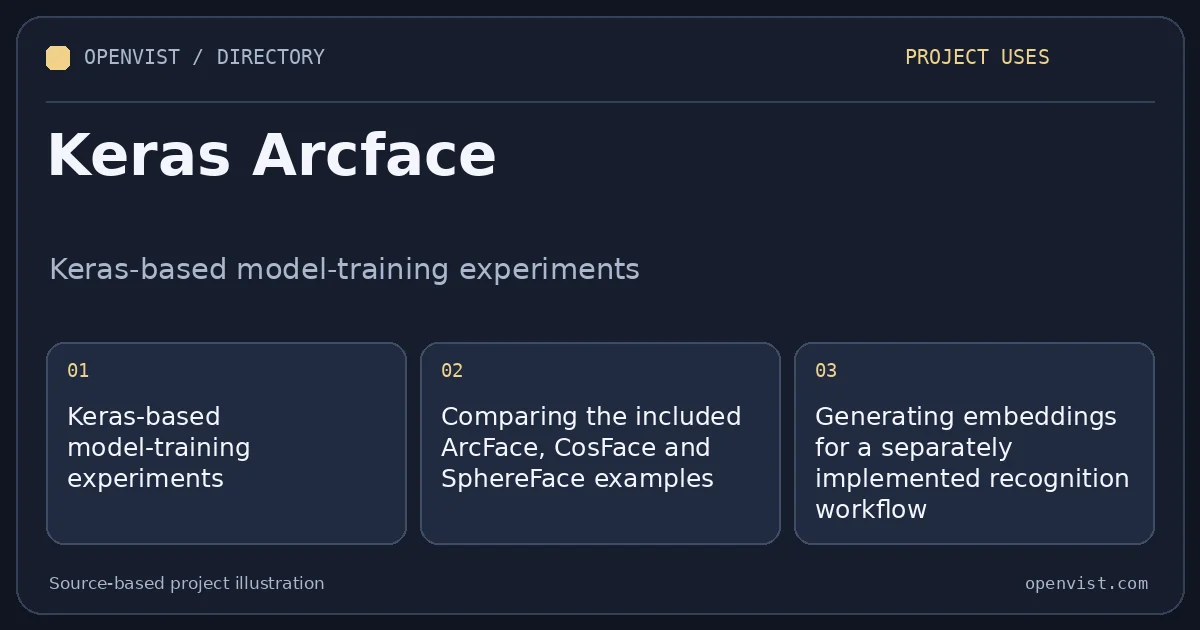
- Add an ArcFace, CosFace or SphereFace head to a Keras model.
- Train a model using labeled inputs.
- Extract and normalize feature embeddings from a trained model.
Before you choose
Requirements & limits
- The README specifies Python 3.6 and Keras 2.2.4.
- The repository is Python-based and carries an MIT license.
- The examples cover model training and embedding extraction, while identity matching is left to downstream implementation.
Check current requirements in the official documentation. Source-based guidance does not mean OpenViST has run or independently tested this project.
Source-based practical guide
Extract normalized embeddings from a trained model
Use the documented example to generate normalized feature vectors from test inputs.
Before you start
- A trained Keras model with saved weights such as model.hdf5
- Python 3.6 and Keras 2.2.4, as listed in the repository requirements
- Test inputs and NumPy
Steps
Load the saved model weights.
Create a model whose inputs use the image input and whose outputs select the documented intermediate layer.
Call predict on the test inputs.
Normalize each resulting feature vector by its L2 norm.
Expected outcome
Normalized feature embeddings are produced for downstream recognition tasks.
Guide limitations
- The example assumes a trained model and saved weights; it does not document a complete identity-matching workflow.
- The repository's stated requirements are Python 3.6 and Keras 2.2.4.
Evidence and transparency
Sources & review
Source record details
- Source availability
- Active
- Sources checked
- 21 November 2026
- Original website title
- 4uiiurz1/keras-arcface · Official homepage title · retained in its source language