
Practical overview
When it fits
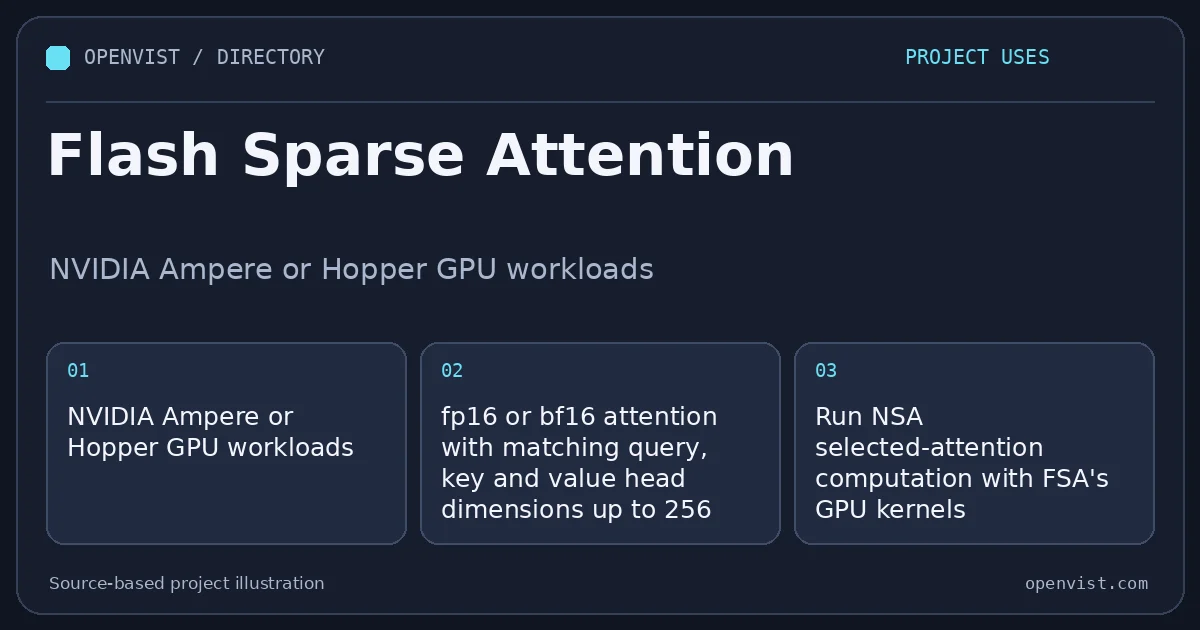
Use FSA when adapting an LLM workload to Native Sparse Attention and its GPU, datatype, head-dimension and GQA configuration fits the repository's documented scope.
Who it is for
- LLM researchers and engineers integrating sparse attention into model training or inference systems.
- GPU systems developers evaluating an optimized NSA selected-attention implementation.
Documented uses
- Run NSA selected-attention computation with FSA's GPU kernels.
- Replace an LLM attention component with the FSA module for training or inference prefill.
- Benchmark forward and backward correctness, performance and memory usage using repository-provided procedures.
Requirements & limits
The implementation is publicly available on GitHub under the Apache-2.0 license.
- The README lists specific minimum versions for PyTorch, Triton, Transformers, Datasets and Accelerate, plus flash-attn 2.6.3.
- Model integration requires constructing the FSA module and computing cumulative sequence lengths.
- The documented workload coverage includes training and inference prefill.
Check current requirements in the official documentation. Source-based guidance does not mean OpenViST has run or independently tested this project.
Install FSA dependencies
Install the repository's listed software dependencies before integrating its attention module.
Before you start
- PyTorch 2.4 or later
- Triton 3.0 or later
- Transformers 4.45.0 or later
- Datasets 3.3.0 or later
- Accelerate 1.9.0 or later
Steps
Obtain the repository's requirements.txt file.
Run the command below.
pip install -r requirements.txt
Expected outcome
The README's listed FSA dependencies are installed through the repository requirements file.
Guide limitations
- This covers dependency installation only; it does not establish that a particular machine or model is compatible.
- FSA's documented tested configurations specify NVIDIA Ampere or Hopper GPUs.
Integrate FSA into an LLM attention module
Replace an LLM attention component with the FSA module and prepare its packed-sequence input.
Before you start
- An environment with the repository's listed dependencies
- A supported NVIDIA GPU workload
- An LLM attention module to adapt
Steps
Instantiate
FlashSparseAttentionwith the model's attention dimensions and sparse-attention parameters.Move the module to CUDA and select fp16 or bf16 as appropriate for the workload.
Compute cumulative sequence lengths (
cu_seqlens) for the packed input.Use the repository's
SparseLlamaAttentionexample as the documented model-integration reference.
Expected outcome
The model's attention component is adapted to call FSA with packed input and cumulative sequence lengths.
Guide limitations
- The repository leaves model-specific integration work to the user.
- The documented tested scope includes training and inference prefill; it does not establish general model-framework compatibility.
Sources & review
Source record details
- Source availability
- Active
- Sources checked
- 8 November 2026
- Original website title
- Relaxed-System-Lab/Flash-Sparse-Attention · Official homepage title · retained in its source language