
Understand the project
Practical overview
When it fits
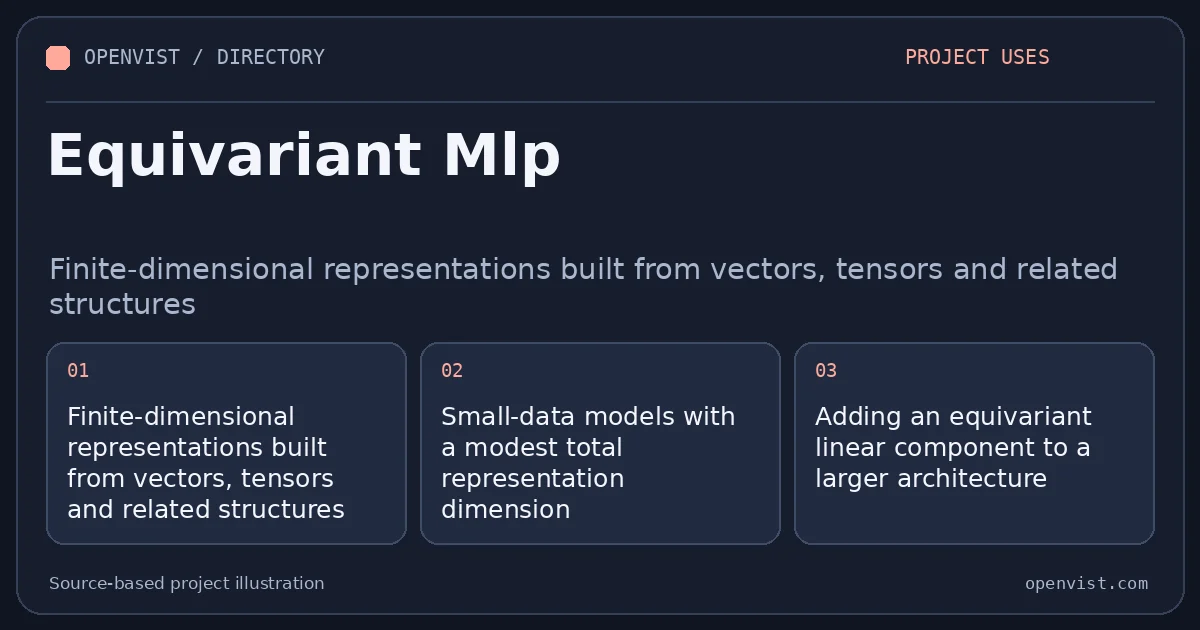
Use it when model inputs and outputs have known matrix-group symmetries and you want equivariant layers or a small-data MLP that encodes those symmetries.
Who it is for
- Machine-learning researchers studying equivariant models and symmetry-aware representations.
- Developers building multilayer perceptrons for small-data problems with structured inputs and outputs.
- Practitioners who need equivariant linear maps as components in a larger model.
Documented uses
- Compute a basis of equivariant linear maps between specified representations.
- Construct an equivariant multilayer perceptron for a chosen symmetry group.
- Visualize equivariant bases and run the repository's documented regression experiments.
Before you choose
Requirements & limits
The repository is public and specifies the MIT license.
- You must specify a symmetry group and compatible input and output representations.
- The README says the approach is no faster than an MLP, making very large flattened inputs a constraint.
- The project describes itself as a poor fit for efficient CNNs, graph neural networks and large image, voxel, graph or point-cloud data.
Check current requirements in the official documentation. Source-based guidance does not mean OpenViST has run or independently tested this project.
Source-based practical guide
Install the repository for paper experiments
Clone and locally install the repository with its experiment extras.
Before you start
- Git and pip.
Steps
Run the command below.
git clone https://github.com/mfinzi/equivariant-MLP.gitChange into the
equivariant-MLPdirectory.Run the command below.
pip install -e .[EXPTS]
Expected outcome
The documented local installation steps for running the repository's experiments are complete.
Guide limitations
- The README's experiment commands are a subsequent stage and are not included in this setup guide.
Evidence and transparency
Sources & review
Source record details
- Source availability
- Active
- Sources checked
- 21 November 2026
- Original website title
- mfinzi/equivariant-MLP · Official homepage title · retained in its source language