
Practical overview
When it fits
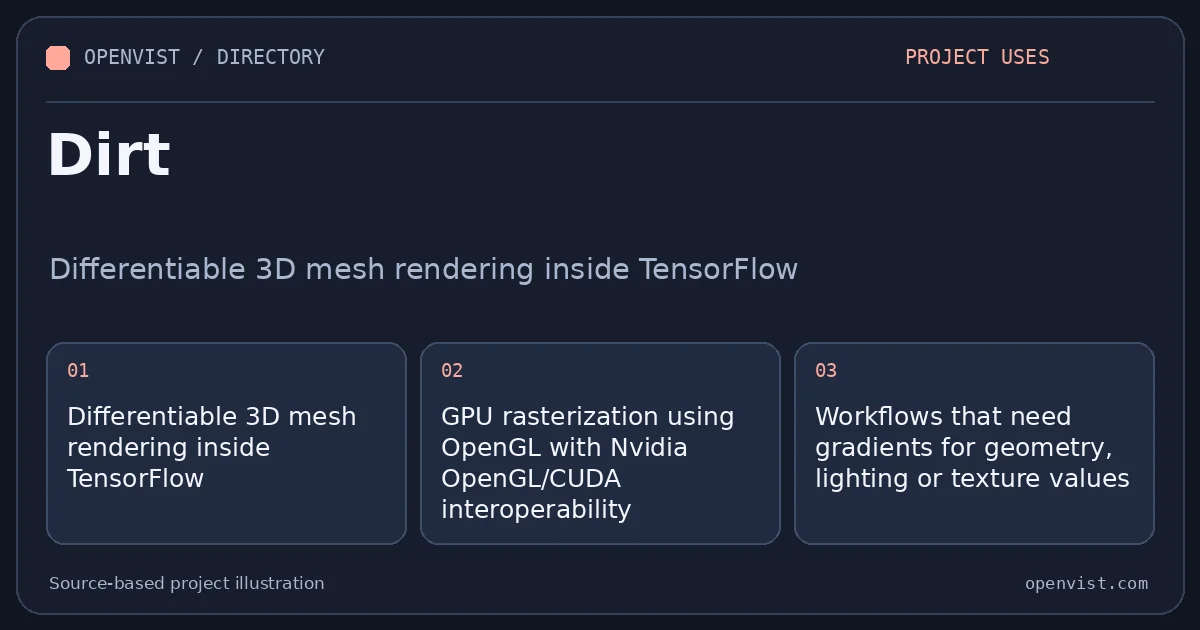
Use DIRT when a TensorFlow workflow needs rendered pixels to remain differentiable with respect to 3D scene inputs, particularly geometry or lighting.
Who it is for
- TensorFlow developers building differentiable rendering into machine-learning or computer-vision workflows.
- Researchers optimizing 3D mesh geometry, lighting or textures against rendered outputs.
Documented uses
- Render 3D meshes as TensorFlow operations.
- Compute gradients through vertex locations, normals, lighting parameters, UV coordinates and texture pixels.
- Build direct or deferred shading workflows for differentiable scene rendering.
Requirements & limits
The project repository is public and specifies the MIT license. Its setup documentation lists Linux, an Nvidia GPU and GPU-enabled TensorFlow among the requirements.
- The documented build targets Linux and requires an Nvidia GPU; Ubuntu is the only Linux distribution the project says it tested.
- The installation instructions target GPU-enabled TensorFlow 1.6 or later and Python 2.7.9 or 3.5 or newer.
- Direct shading is described as efficient but limited for effects such as specular highlights and does not support texturing; deferred shading handles per-pixel lighting and textures.
- DIRT follows OpenGL clip-space and camera-axis conventions, while output images follow TensorFlow’s top-row-first convention.
Check current requirements in the official documentation. Source-based guidance does not mean OpenViST has run or independently tested this project.
Install DIRT from its repository
Set up the library in a Python environment with GPU-enabled TensorFlow.
Before you start
- Nvidia GPU; the project reports testing drivers from version 367 onward.
- Linux; Ubuntu is the only distribution tested by the project.
- GPU-enabled TensorFlow 1.6 or later, with tensorflow-gpu active in the virtual environment before installation.
- Python 2.7.9 or Python 3.5 or newer, CMake 3.8 or newer, and GCC 4.9 or newer.
Steps
Activate a virtual environment that has tensorflow-gpu installed.
Clone https://github.com/pmh47/dirt.git and change into the dirt directory.
Run pip install . from the repository directory.
For the documented build sanity check, run python tests/square_test.py.
Expected outcome
DIRT is installed in the active Python environment; the README says the square test should report “successful: all pixels agree.”
Guide limitations
- The project says Linux is required and Ubuntu is the only distribution it tested; it does not document Windows or macOS support in these setup instructions.
- OpenGL/EGL development libraries and Nvidia driver library paths may need attention if the build cannot find required headers or libraries.
Sources & review
Source record details
- Source availability
- Active
- Sources checked
- 20 November 2026
- Original website title
- pmh47/dirt · Official homepage title · retained in its source language
Related options
DEODR — Named in DIRT’s README as another differentiable renderer; the README says it supports Gouraud shading with textures.