
Practical overview
When it fits
Use DeepFRI when you have protein sequence or supported structural inputs and want model-generated function predictions in CSV or JSON, optionally with saliency-map outputs.
Who it is for
- Researchers analyzing protein function from sequence or structural data.
- Developers and computational biology teams seeking an open-source Python model workflow for ontology-based prediction.
Documented uses
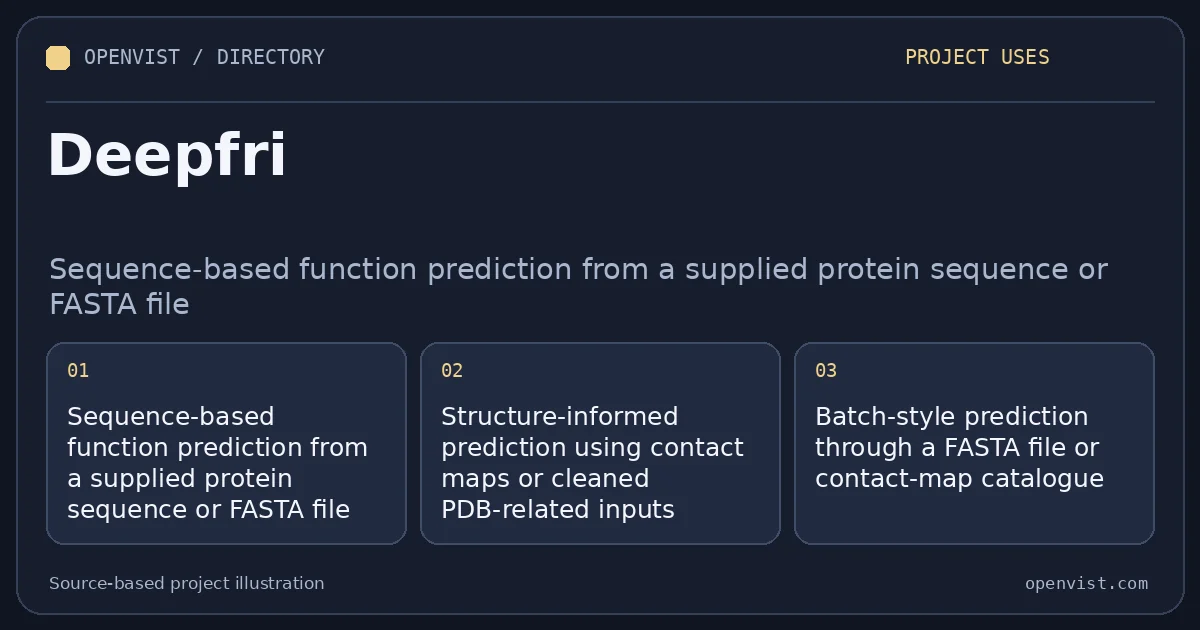
- Predict function labels for a protein from its sequence or structural inputs.
- Process multiple sequences from a FASTA file or proteins listed in a contact-map catalogue.
- Choose among Molecular Function, Biological Process, Cellular Component and Enzyme Commission prediction ontologies.
- Generate optional class-activation saliency maps for predicted functions.
Requirements & limits
The repository is public, open source and lists a BSD-3-Clause license. The README documents a local Python installation and command-line workflow.
- The README lists Python 3.7 as the version under which the project was tested, plus TensorFlow, Biopython and scikit-learn dependencies.
- Input preparation varies by method: contact-map inputs use
.npzfiles containingC_alphaandseqres; other documented inputs include FASTA and cleaned PDB files. - Prediction requires choosing one of the listed ontology codes:
mf,bp,ccorec. - Saliency output is optional and produces JSON class-activation maps; prediction outputs can include CSV and JSON files.
Check current requirements in the official documentation. Source-based guidance does not mean OpenViST has run or independently tested this project.
Install DeepFRI dependencies
Install the project and its listed dependencies before following the repository's prediction examples.
Before you start
- Python environment; the README says DeepFRI was tested to work under Python 3.7.
- TensorFlow, Biopython and scikit-learn are listed dependencies.
Steps
From the repository, run the command below as directed in the README.
pip install .Refer to the README's prediction options and examples for the next stage, including input selection and ontology.
Expected outcome
The repository's installation step for DeepFRI and its dependencies is specified; the README then documents prediction through `predict.py`.
Guide limitations
- This guide covers installation only; it does not verify a successful installation or prediction.
- The README's examples require selecting suitable sequence, FASTA, contact-map or structure-related inputs and a model configuration.
Sources & review
Source record details
- Source availability
- Active
- Sources checked
- 16 November 2026
- Original website title
- flatironinstitute/DeepFRI · Official homepage title · retained in its source language