
Practical overview
When it fits
Use it when you want to experiment with a local Tacotron 2-based multilingual model using speech data labeled by transcript, speaker and language.
Who it is for
- Developers preparing custom text-and-audio datasets for multilingual speech synthesis.
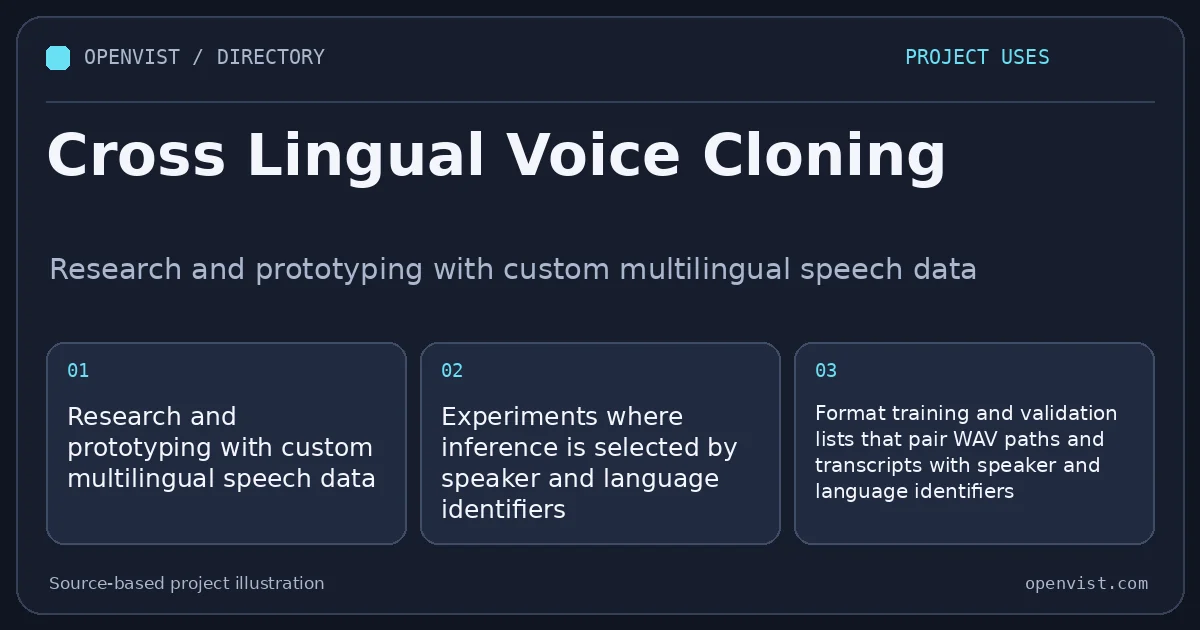
- Researchers prototyping cross-language voice cloning and comparing speech generation across languages.
Documented uses
- Format training and validation lists that pair WAV paths and transcripts with speaker and language identifiers.
- Configure the model's speaker and language counts and adjust its supported character set.
- Run the documented inference notebook with selected speaker and language numbers.
Requirements & limits
The repository is public and identifies its license as BSD-3-Clause. The model is self-hosted rather than described as a hosted service.
- Training examples need WAV paths, matching text, speaker IDs and language IDs in the specified pipe-separated format.
- The README requires separate training and validation lists and corresponding hyperparameter paths.
- The inference instructions refer to clvc-infer-gh.ipynb; older Tacotron 2 material names a different notebook and discusses separate pretrained models.
- The older setup notes specify an NVIDIA GPU with CUDA and cuDNN, while the repository does not give a consolidated environment specification for the multilingual workflow.
Check current requirements in the official documentation. Source-based guidance does not mean OpenViST has run or independently tested this project.
Prepare labeled data and settings for multilingual training
Configure the dataset files and model counts required by the repository's training format.
Before you start
- WAV audio files paired with their corresponding text
- A training text file and a validation text file
- Speaker and language identifiers numbered from zero
Steps
Create one line per audio example in the format WAV path|corresponding text|speaker number|language number.
Set hparams.training_files and hparams.validation_files to the two text-file paths.
Set hparams.n_speakers and hparams.n_langs to the counts represented in the data.
Adjust the _letters variable in text/symbols.py if the language character set needs to change.
Expected outcome
The dataset file lists and speaker, language and character settings are configured for the documented training workflow.
Guide limitations
- The README does not give a complete training command for this modified multilingual workflow.
- The older setup notes list NVIDIA GPU, CUDA and cuDNN as prerequisites, but do not establish the current notebook's full environment requirements.
Sources & review
Source record details
- Source availability
- Active
- Sources checked
- 16 November 2026
- Original website title
- deterministic-algorithms-lab/Cross-Lingual-Voice-Cloning · Official homepage title · retained in its source language