
Practical overview
When it fits
Use it when a Julia workflow needs a composable representation of preprocessing and model steps that can be fitted and evaluated together.
Who it is for
- Julia developers building or comparing machine-learning workflows.
- Data scientists combining preprocessing, feature transformations and learners in one pipeline.
- Developers extending the package with custom filters, transformers or learners.
Documented uses
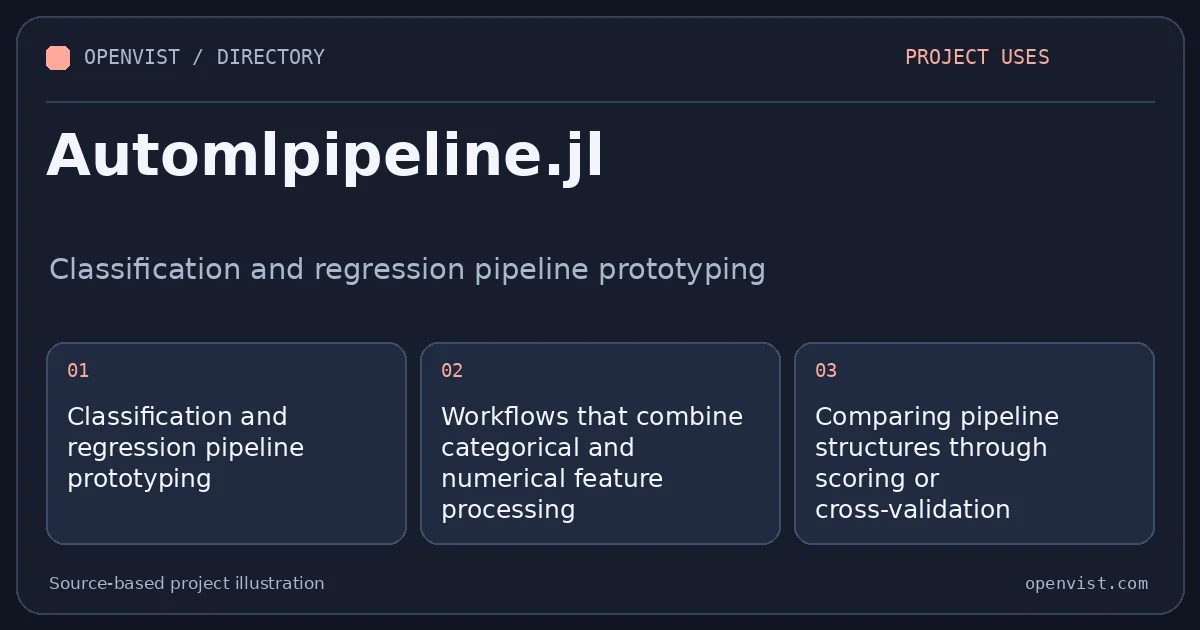
- Compose multiple preprocessing branches and a model using symbolic pipeline expressions.
- Fit a pipeline on training features and targets, produce predictions, and score results.
- Cross-validate a workflow with a selected metric.
- Add custom pipeline components through the fit! and transform! interfaces.
Requirements & limits
The repository lists the package in Julia’s official package registry and gives Julia’s package manager as the installation route. The repository metadata lists an MIT license.
- The package uses Julia and its symbolic expression and macro capabilities.
- The README identifies DataFrames as the main data-exchange format.
- The documented interface separates feature-processing components from learners and supports extension through fit! and transform!.
Check current requirements in the official documentation. Source-based guidance does not mean OpenViST has run or independently tested this project.
Install AutoMLPipeline.jl from Julia’s package manager
Add the registered package to a Julia environment.
Before you start
- A Julia prompt with Julia’s package manager available.
Steps
At the Julia prompt, enter ] to open package-manager mode.
Run update.
Run add AutoMLPipeline.
Expected outcome
The package is added to the active Julia environment.
Guide limitations
- This covers installation only; it does not configure a dataset or run a pipeline.
Fit and score a classification pipeline
Compose preprocessing and a classifier, then evaluate predictions and cross-validation.
Before you start
- AutoMLPipeline.jl installed in Julia.
- Feature inputs in a DataFrame and a one-dimensional target vector.
- Training and test data, plus the pipeline operators used in the expression.
Steps
Compose feature-processing branches and a learner using pipeline expressions, such as categorical one-hot encoding and numerical PCA or ICA followed by a random-forest classifier.
Call fit!(model, Xtrain, Ytrain) to fit the model.
Call transform!(model, Xtest) to obtain predictions.
Evaluate with score(:accuracy, prediction, Ytest), or use crossvalidate(model, X, Y, "balanced_accuracy_score").
Expected outcome
A fitted pipeline produces test predictions and can be scored or cross-validated.
Guide limitations
- The README notes that + has higher precedence than |>; use parentheses to make grouping explicit when needed.
- The example does not specify dataset-specific choices or performance results.
Sources & review
Source record details
- Source availability
- Active
- Sources checked
- 16 November 2026
- Original website title
- IBM/AutoMLPipeline.jl · Official homepage title · retained in its source language