
Understand the project
Practical overview
When it fits
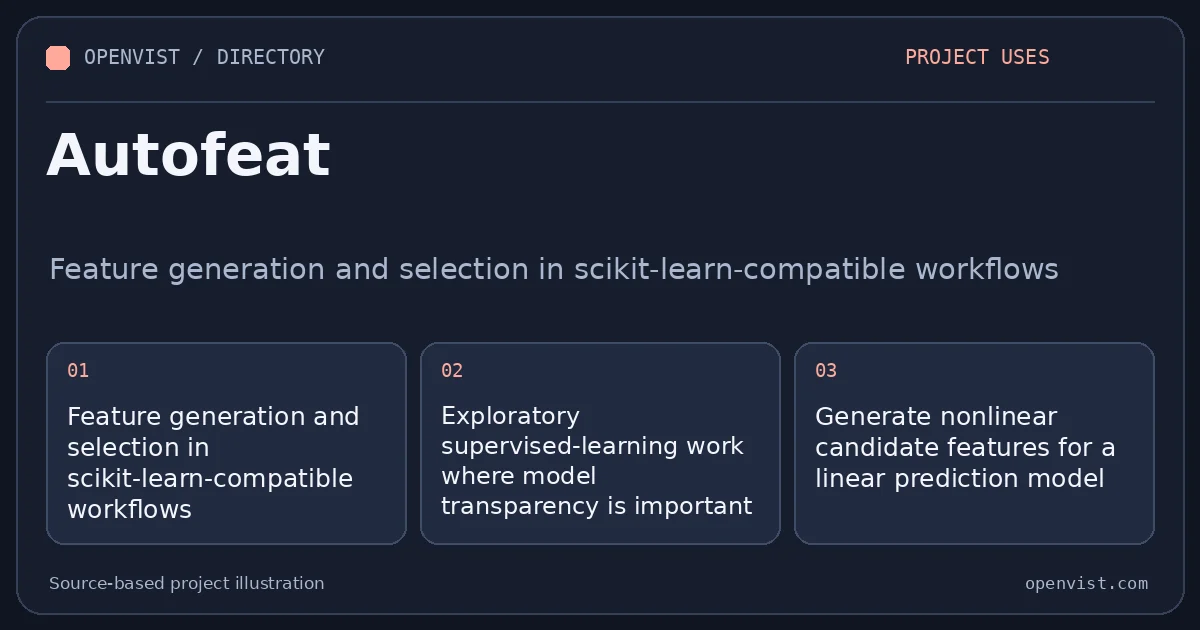
Use it when supervised prediction requires exploring nonlinear transformations but the workflow should retain a linear model structure.
Who it is for
- Python practitioners building supervised-learning workflows with scikit-learn.
- Researchers exploring feature selection or nonlinear transformations while retaining a linear model structure.
Documented uses
- Generate nonlinear candidate features for a linear prediction model.
- Select a smaller subset of engineered features.
- Compare a linear workflow with and without automatically engineered features.
Before you choose
Requirements & limits
- The README lists NumPy, pandas, scikit-learn, SymPy, joblib, Pint, and Numba as dependencies.
- The project labels its code as intended for research and cautions that outcomes vary by dataset and use case.
- The repository specifies an MIT license.
Check current requirements in the official documentation. Source-based guidance does not mean OpenViST has run or independently tested this project.
Source-based practical guide
Install Autofeat and its listed dependencies
Prepare a Python environment with the package and dependencies named in the project README.
Before you start
- Python package installation with pip
Steps
Install Autofeat with the command below.
pip install autofeatEnsure the listed dependencies are available: numpy, pandas, scikit-learn, sympy, joblib, pint, and numba.
Expected outcome
Autofeat and the README-listed dependencies are installed in the Python environment.
Guide limitations
- These steps cover installation only; they do not document a model-training procedure.
- The project describes the code as intended for research and says results vary by dataset and use case.
Evidence and transparency
Sources & review
Source record details
- Source availability
- Active
- Sources checked
- 11 November 2026
- Original website title
- cod3licious/autofeat · Official homepage title · retained in its source language