
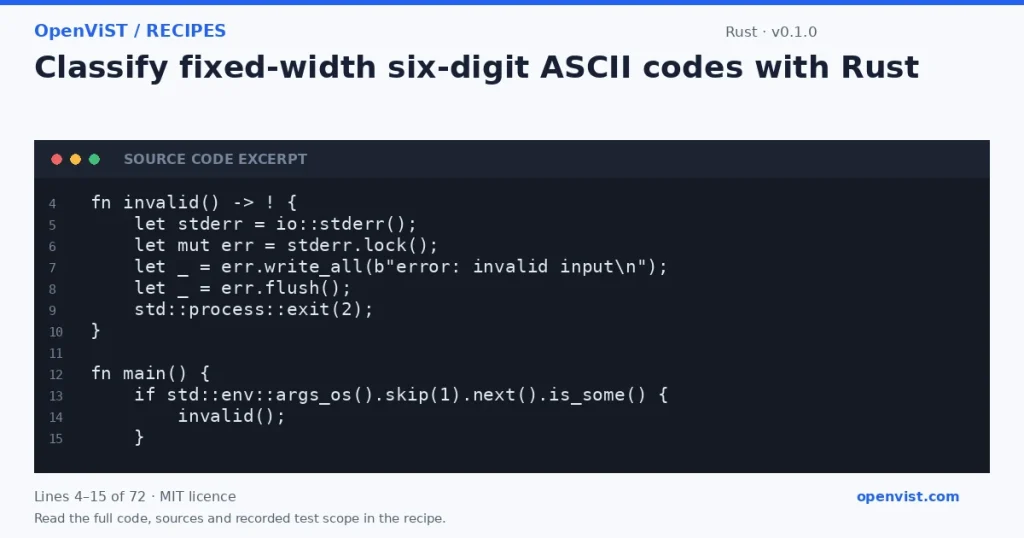
Validate a width-sensitive decimal code convention while preserving the meaning of leading zeroes. Work only with supplied input; this does not contact external services or modify input.
Before you start
- Save as recipe.rs and compile using Rust 1.99.0: rustc --edition=2021 recipe.rs -o recipe
- Run recipe with input supplied on stdin and no CLI arguments. Help flags are rejected.
- Reads at most 65537 bytes and rejects input exceeding 65536 bytes. Requires strict UTF-8, rejects a leading UTF-8 BOM, and rejects every CR byte, including CRLF.
- Splits only on LF and discards exactly empty segments. Retains at most 100 nonempty lines, each at most 256 UTF-8 bytes. All limits are enforced before classification; no trimming, normalization, grouping or deduplication occurs.
- Each retained line produces one boolean, in input order. Only exactly six ASCII digits are valid. Leading zeroes are preserved and accepted; no numeric parsing occurs. Other spellings within the input limits produce false.
- Success exits 0, emits exactly one JSON object of the form {"valid":[boolean,...]} followed by a newline, and writes no stderr. Empty input or only LF characters produces {"valid":[]}.
- Invalid arguments, invalid input and stdin-read failures exit 2 with no stdout and exactly error: invalid input followed by a newline on stderr, subject to the output-write limitation below. Diagnostics do not contain input values.
Build and check
- Save the example as recipe.rs.
- Compile with Rust 1.99.0 using rustc --edition=2021 recipe.rs -o recipe.
- Prepare UTF-8 input.txt following the documented operation-specific conventions.
- Run ./recipe < input.txt.
- Inspect the JSON result. Exit 2 with exactly error: invalid input followed by a newline on stderr and no stdout identifies rejected input or stdin-read failure. Output-write failures may also exit nonzero, without that diagnostic and potentially after partial stdout; these are outside the input-error guarantee.
Limits to understand
- Memory use is bounded by a 65537-byte input buffer, storage for at most 100 borrowed line references, a JSON output buffer of at most 612 bytes, and standard I/O and allocation overhead.
- Stdin can block while waiting for input or EOF. There is no timeout. Reading stops and rejects immediately once 65537 bytes have been obtained.
- Successful output can be sensitive: it reveals the number and ordering of retained lines and their validity classifications, although it does not echo their contents.
- Memory-allocation failures and output-write failures are outside the input-error guarantee. A detected stdout write or flush failure exits 1 and may leave partial stdout; stderr failures can prevent delivery of the complete error diagnostic.
- Uses only the standard library, stdin, stdout and stderr, plus argument inspection solely to reject arguments and process exit solely to set status. No filesystem, network, subprocess or dynamic-loading access is used.
Run it
rustc --edition=2021 recipe.rs -o recipe
./recipe < input.txt
Example input
000000
123456
12345
1234567
Expected output
{"valid":[true,true,false,false]}