
Practical overview
When it fits
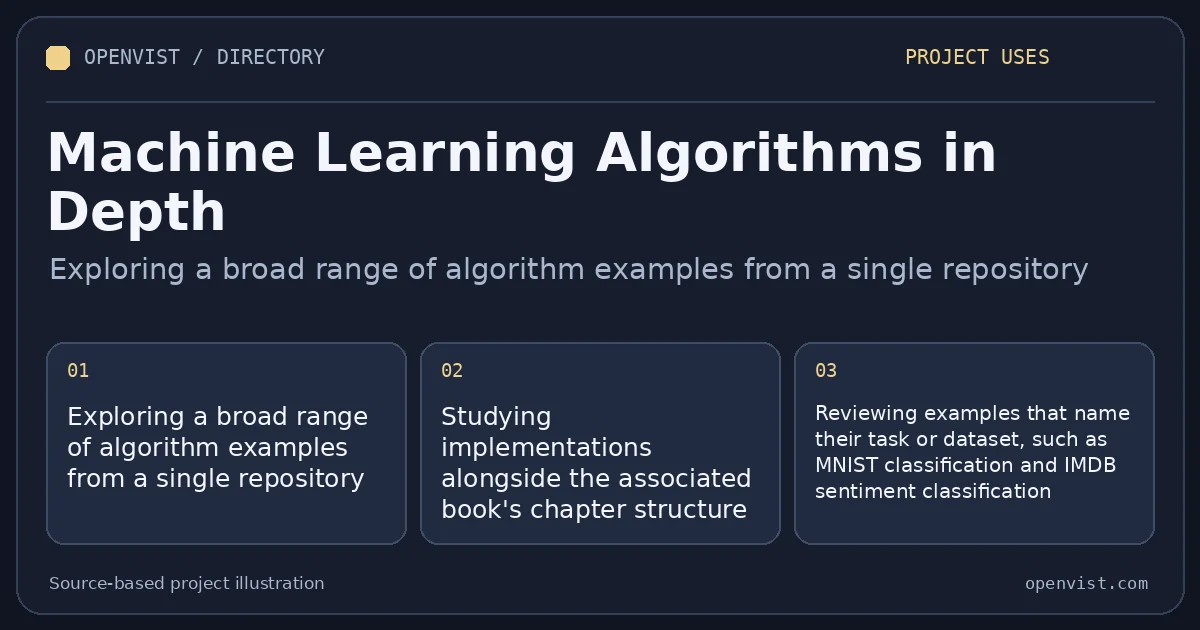
Use it when you want chapter-based Python examples to accompany study of a particular algorithm or model family.
Who it is for
- Readers studying machine-learning methods through code examples
- Python users comparing implementations across inference, classification, regression and unsupervised learning
- Instructors or learners exploring neural-network examples tied to named datasets
Documented uses
- Inspect sampling and variational-inference examples to study Bayesian methods.
- Compare examples of classification and regression approaches.
- Explore unsupervised methods such as Gaussian mixture models, PCA and t-SNE.
- Examine neural-network demonstrations for image, sentiment, text and graph tasks.
Requirements & limits
The repository is public on GitHub. Its README documents Python virtual-environment setup for Linux and Windows.
- The collection spans classical algorithms, Bayesian methods and deep learning rather than focusing on a single model.
- Examples are organized by chapters, with individual scripts linked from the README.
- The documented setup installs dependencies from requirements.txt; the README does not provide one universal run command.
Check current requirements in the official documentation. Source-based guidance does not mean OpenViST has run or independently tested this project.
Set up the documented Python environment
Create and activate a virtual environment, then install the repository's listed Python requirements.
Before you start
- A Linux or Windows environment
- Python 3 and pip
- A checkout of the repository containing requirements.txt
Steps
Create an environment with the command below.
python3 -m venv ml-algoActivate it on Linux with
source ml-algo/bin/activate, or on Windows with the documented CMD or PowerShell activation command.Install dependencies with the command below.
pip install -r requirements.txt
Expected outcome
A virtual environment with the dependencies listed by the repository installed.
Guide limitations
- The README documents environment setup, not a common command for running all examples.
Sources & review
Source record details
- Source availability
- Active
- Sources checked
- 21 November 2026
- Original website title
- vsmolyakov/ml_algo_in_depth · Official homepage title · retained in its source language