
Practical overview
When it fits
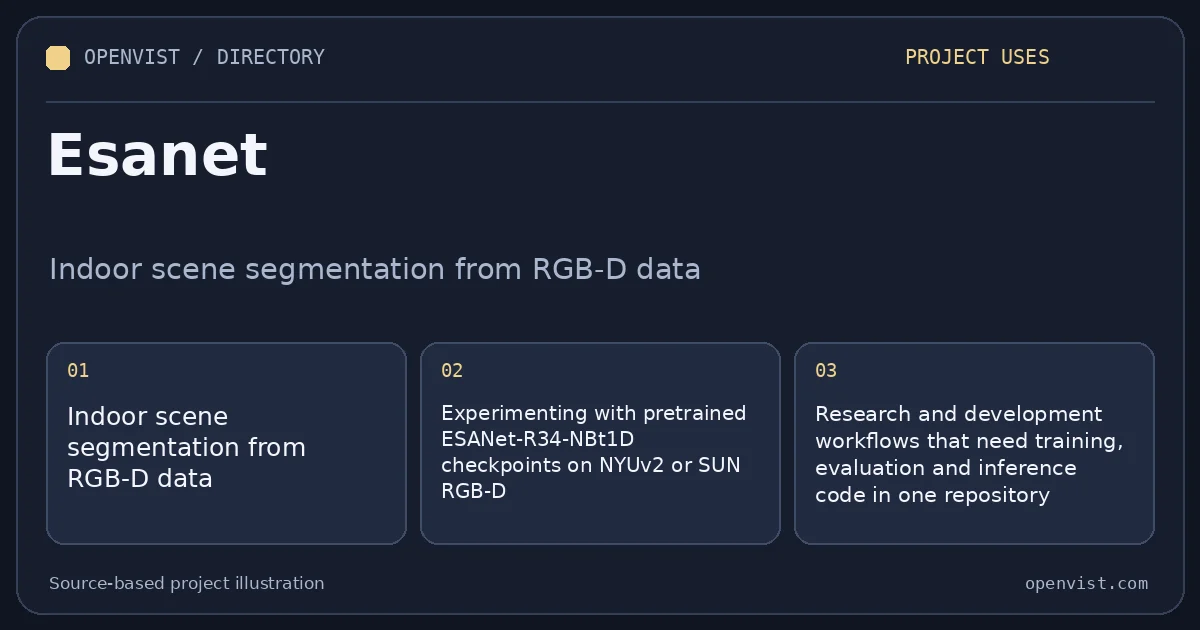
Use ESANet when a project needs RGB-D semantic segmentation as a component of scene analysis, especially for indoor perception or a mobile-robot pipeline.
Who it is for
- Researchers evaluating RGB-D semantic segmentation on indoor-scene datasets.
- Developers building perception pipelines for mobile robots.
- Practitioners who need sample or dataset inference and can work with Python, PyTorch and prepared model inputs.
Documented uses
- Generate semantic labels from paired color and depth images.
- Train or evaluate the networks using supported scene datasets.
- Apply a trained checkpoint to sample images or prepared dataset samples.
- Convert models to ONNX or TensorRT and measure inference time.
Requirements & limits
The public repository states that its source code is licensed under Apache 2.0.
- Color and depth inputs are used together; sample inference requires the dataset setting for preprocessing and class colors.
- Dataset inference requires prepared data, while sample inference can use the images in ./samples without preparing the full dataset.
- The README documents a current Python 3.12 and PyTorch 2.9.1 setup, alongside a separate original-publication environment.
- The reported Jetson AGX Xavier real-time result and historical timing setup are hardware- and software-specific.
- The repository describes Cityscapes use as an outdoor application as well as indoor scene analysis.
Check current requirements in the official documentation. Source-based guidance does not mean OpenViST has run or independently tested this project.
Run inference on the included sample images
Apply a provided trained checkpoint to sample images using the repository's sample-inference script.
Before you start
- A repository environment set up using one of the documented Conda options.
- A trained checkpoint, such as the provided ESANet-R34-NBt1D weights for SUNRGB-D or NYUv2.
- Sample images in ./samples.
Steps
Choose the dataset associated with the checkpoint: sunrgbd or nyuv2.
Run inference_samples.py with the matching --dataset and --ckpt_path arguments.
For the documented examples, include --raw_depth and set --depth_scale to 1 for SUNRGB-D or 0.1 for NYUv2.
Expected outcome
The script applies the selected model to the sample images and produces a segmentation visualization.
Guide limitations
- The dataset argument is needed for preprocessing and class colors, even when the dataset itself has not been prepared.
- Depth scaling may require adjustment for other depth inputs or training datasets.
Apply a trained model to prepared SUN RGB-D data
Run dataset inference on samples from SUN RGB-D using the matching provided checkpoint.
Before you start
- A repository environment set up using one of the documented Conda options.
- SUN RGB-D data prepared according to the repository instructions and stored at ./datasets/sunrgbd.
- The ESANet-R34-NBt1D checkpoint at ./trained_models/sunrgbd/r34_NBt1D_scenenet.pth.
Steps
Prepare the dataset using the repository's SUN RGB-D instructions.
Use inference_dataset.py with --dataset sunrgbd, --dataset_dir ./datasets/sunrgbd and the matching --ckpt_path.
Set --batch_size 4 as in the documented example.
Expected outcome
The script applies the trained model to dataset samples and visualizes the first batch.
Guide limitations
- The dataset must be prepared and stored in the expected location.
- Larger batch sizes make the visualized images smaller.
Compare options for Model inference and serving
These projects document a common task and share a project role. This is a source-based comparison, not an execution benchmark or a guarantee of interchangeability.
| Project | Documented purpose | Platform | Access and requirements |
|---|---|---|---|
| Esanet | Generate semantic labels from paired color and depth images. | Linux | The public repository states that its source code is licensed under Apache 2.0. |
| Ling V2 | Generate text from chat prompts using Ling-mini-2.0 and Transformers. | The repository is public and identifies the project as open source under the MIT license. Model downloads are linked through Hugging Face and ModelScope. | |
| YOLO2 Light | Compile a YOLO object detector for CPU or CUDA GPU execution. | Windows, Linux | The repository is public and identifies the MIT license. |
Sources & review
Source record details
- Source availability
- Active
- Sources checked
- 21 November 2026
- Original website title
- TUI-NICR/ESANet · Official homepage title · retained in its source language