
Practical overview
When it fits
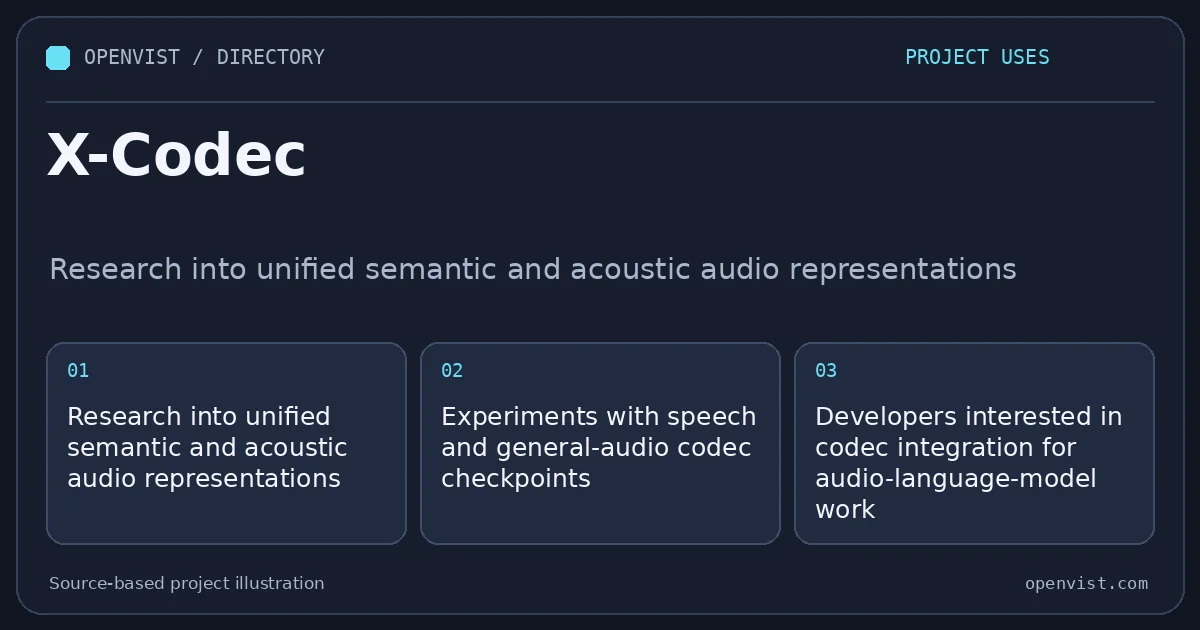
Use X-Codec when researching audio-language-model representations or adapting an acoustic codec with a semantic component. The repository describes both inference and training workflows, while pointing to its code and configuration for implementation details.
Who it is for
- Researchers studying semantic information in audio codecs and audio language models.
- Developers exploring speech or general-audio codec implementations and experiments.
Documented uses
- Explore how semantic and acoustic audio features can be combined and quantized.
- Use listed speech or general-audio checkpoints for inference.
- Prepare audio-file lists and configuration for model training.
- Investigate codec use in VALL-E experiments.
Requirements & limits
The repository is public and identifies the project as MIT-licensed. It lists Transformers-compatible checkpoints on Hugging Face.
- The listed checkpoints vary by semantic model, audio domain, and training data.
- The README documents inference and training stages but does not provide a complete dependency list or runtime-platform requirements.
- The repository presents VALL-E as an experiment, not as a complete speech-generation application.
Check current requirements in the official documentation. Source-based guidance does not mean OpenViST has run or independently tested this project.
Prepare audio file lists for X-Codec training
Create the training and validation file lists that X-Codec training expects.
Before you start
- Paths to the audio files to include in the lists.
- A configuration containing the training_file and validation_file settings.
Steps
Create a training file list with one audio-file path per line.
Create a validation file list with one audio-file path per line.
Set training_file and validation_file in the configuration to refer to the respective lists.
Expected outcome
Training and validation lists are prepared in the format described for the training configuration.
Guide limitations
- The instructions do not specify configuration syntax or paths for the list files.
- No dependency installation, model preparation, or training execution details are provided.
Sources & review
Source record details
- Source availability
- Active
- Sources checked
- 20 November 2026
- Original website title
- zhenye234/xcodec · Official homepage title · retained in its source language