
Understand the project
Practical overview
When it fits
Use it when you want a script-based PyTorch workflow for training token embeddings and an RVAE, then sampling generated text.
Who it is for
- Developers exploring or adapting a PyTorch recurrent variational autoencoder for text generation.
- Researchers working with sequential text models and token embeddings.
Documented uses
- Train word embeddings for a text-generation workflow.
- Train an RVAE model on sequential text.
- Sample generated sequences after model training.
Before you choose
Requirements & limits
The repository is public and lists the MIT license.
- The documented workflow requires training word embeddings before model training.
- Scripts expose settings including iteration counts, batch size and, for model training, learning rate and decoder-input dropout.
- CUDA is listed as an optional command-line setting; the documentation does not specify hardware requirements.
Check current requirements in the official documentation. Source-based guidance does not mean OpenViST has run or independently tested this project.
Source-based practical guide
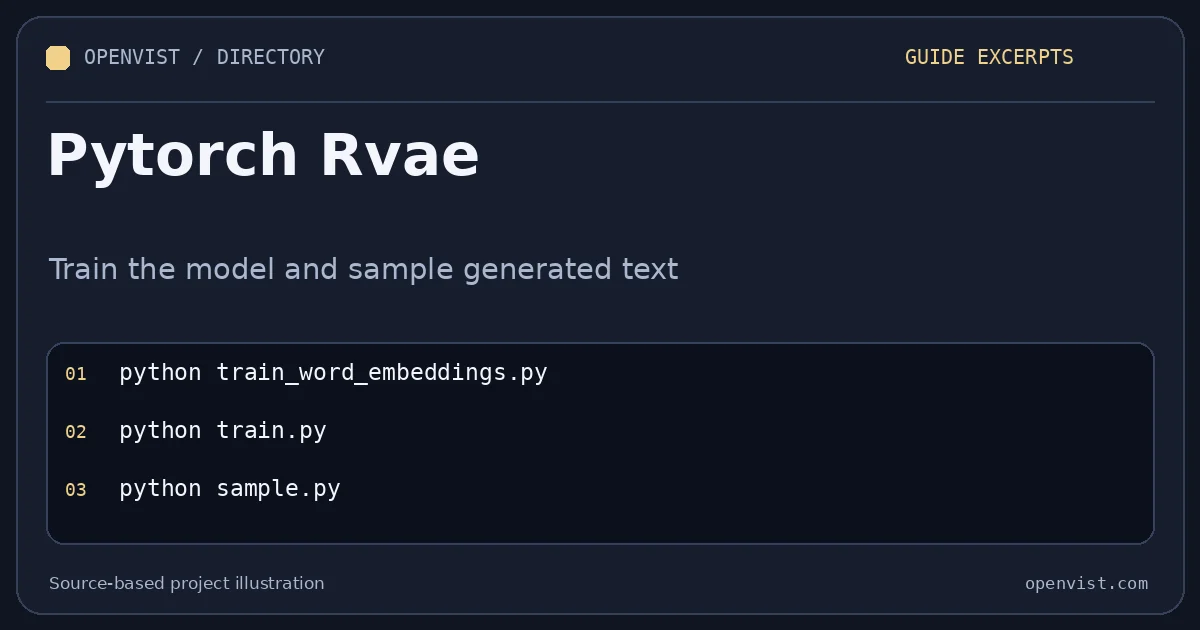
Train the model and sample generated text
Follow the repository's documented sequence from training word embeddings to sampling model output.
Before you start
- Python environment for running the repository scripts
- A text corpus for the embedding and model training workflow
Steps
Run the command below to train word embeddings.
python train_word_embeddings.pyRun the command below to train the recurrent variational autoencoder.
python train.pyRun the command below to sample generated sequences.
python sample.py
Expected outcome
Generated sequential text sampled from the trained model.
Guide limitations
- The README lists command-line parameters but does not specify corpus preparation or provide a complete environment setup.
Evidence and transparency
Sources & review
Source record details
- Source availability
- Active
- Sources checked
- 16 November 2026
- Original website title
- kefirski/pytorch_RVAE · Official homepage title · retained in its source language