
Practical overview
When it fits
Use it when you need research code and documented MATLAB examples for monaural singing-voice separation, speech separation or speech denoising, rather than a ready-made general audio application.
Who it is for
- Researchers studying monaural audio source separation or speech denoising.
- MATLAB users who want to inspect or adapt experiment-specific audio separation workflows.
Documented uses
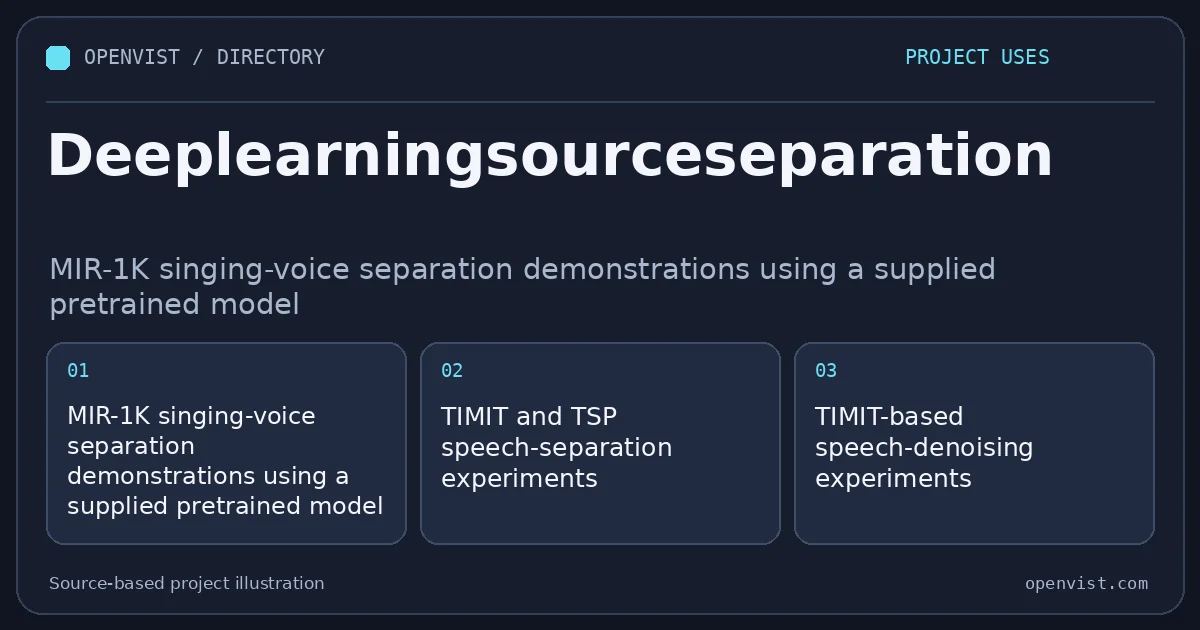
- Run a pretrained singing-voice separation demonstration on the MIR-1K experiment.
- Explore speech-separation examples built around TIMIT or TSP data.
- Run or study a TIMIT-based speech-denoising example.
- Prepare MIR-1K or TSP data in the repository’s designated directories and tune experiment parameters using a development set.
Requirements & limits
- MATLAB is the documented implementation language; the README says the code was tested with MATLAB R2015a.
- The pretrained demonstrations require downloading the matching model file and placing it in the experiment-specific demo directory.
- The listed supporting tools include minFunc, HTK and labrosa signal-processing functions; BSS Eval is listed for evaluation.
- The repository names MIR-1K, TIMIT and TSP in connection with its example tasks and data.
- The instructions for user data specifically describe MIR-1K and TSP directories, parameter review and development-set tuning.
Check current requirements in the official documentation. Source-based guidance does not mean OpenViST has run or independently tested this project.
Run the MIR-1K singing-voice separation demo
Place the provided pretrained model in the MIR-1K demo folder and run the documented MATLAB test script.
Before you start
- MATLAB; the repository says its code was tested with MATLAB R2015a.
- The MIR-1K pretrained model file model_400.mat.
- The repository files, including codes/mir1k/demo/run_test_single_model.m.
Steps
Download model_400.mat from the model URL given in the repository README.
Place the model in codes/mir1k/demo.
Go to that folder and run codes/mir1k/demo/run_test_single_model.m.
Expected outcome
Runs the repository’s documented MIR-1K demonstration for singing-voice separation.
Guide limitations
- This recipe covers the pretrained demonstration, not training a new model.
- The README does not specify output details or guarantee results on other MATLAB versions.
Prepare user audio for the documented MIR-1K or TSP workflow
Place user data in an experiment’s documented location and identify the training parameters to tune.
Before you start
- MATLAB and the repository files.
- Audio data for the chosen MIR-1K or TSP experiment.
- A development set for parameter tuning and result checks.
Steps
For MIR-1K, place data in codes/mir1k/Wavfile; for TSP, use codes/TSP/Data/.
Review the unit-test parameters in codes/mir1k/train_mir1k_demo.m or codes/TSP/train_TSP_demo_mini_clip.m, as applicable.
Tune parameters on the development set and check the results.
Expected outcome
Prepares experiment-specific data locations and points to the scripts and development-set tuning stage described by the project.
Guide limitations
- The README does not provide a complete user-data execution procedure or guarantee that arbitrary audio will work.
- The guide does not cover model training or deployment beyond the stated preparation and tuning directions.
Sources & review
Source record details
- Source availability
- Active
- Sources checked
- 16 November 2026
- Original website title
- posenhuang/deeplearningsourceseparation · Official homepage title · retained in its source language