
Practical overview
When it fits
Use it when a project needs a research codebase and foundation model for hyperspectral image analysis, with task-specific fine-tuning paths documented in the repository.
Who it is for
- Researchers working with hyperspectral imagery
- Developers building task-specific hyperspectral computer-vision experiments
Documented uses
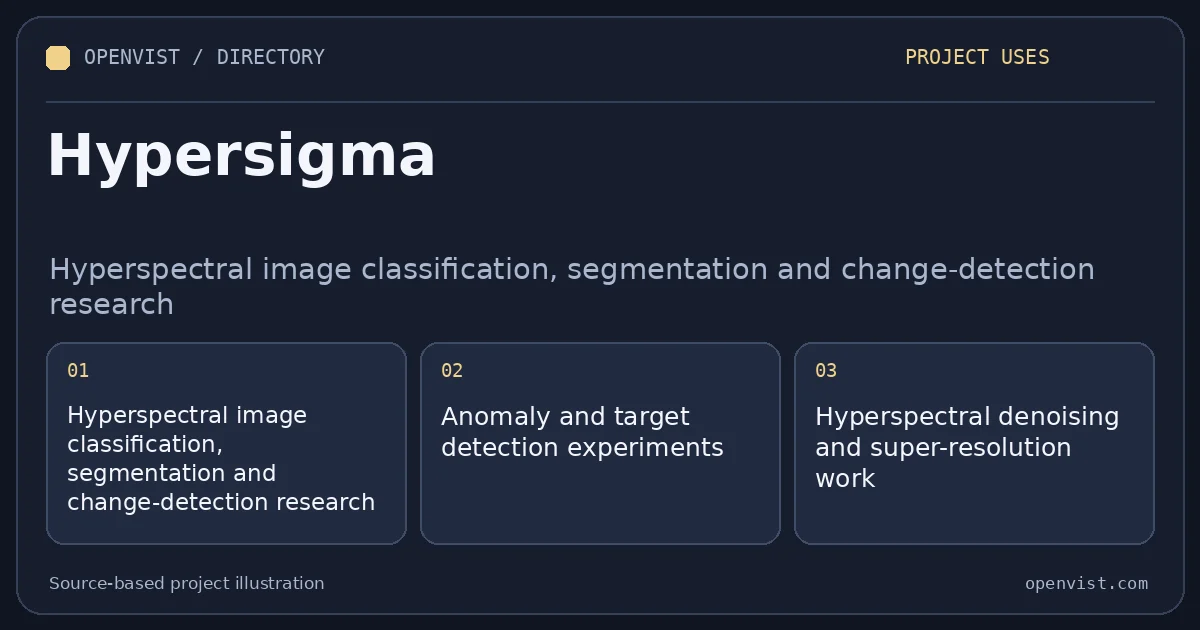
- Fine-tune a model for hyperspectral image classification or segmentation
- Explore hyperspectral change, anomaly or target detection
- Investigate denoising and super-resolution for hyperspectral images
- Pretrain spatial or spectral model variants using the documented SLURM examples
Requirements & limits
The public repository is licensed under Apache-2.0 and links pretrained models on Hugging Face and Baidu Drive.
- The project is focused on hyperspectral imagery; its README also documents a multispectral change-detection path.
- Pretraining examples use SLURM and DCU accelerators and require training data and output/log paths.
- Task fine-tuning guidance is separated into repository sections for classification, detection, change detection, unmixing, denoising and super-resolution.
Check current requirements in the official documentation. Source-based guidance does not mean OpenViST has run or independently tested this project.
Pretrain HyperSIGMA Spatial ViT large with SLURM
Launch the documented large Spatial ViT pretraining example using a SLURM allocation.
Before you start
- SLURM environment with the documented
srunoptions available. - Pretraining data path, model output directory, and log directory.
Steps
Replace
[pretrain data path],[model saved patch], and[log saved path]with the corresponding paths.Run the documented
sruncommand with the command below, modelspat_mae_l, and the listed training parameters.python main_pretrain_Spat.pyTo recover training, pass
--resume [path of saved model].
Expected outcome
The command starts the documented Spatial ViT large pretraining job; the README specifies output and log directories as arguments.
Guide limitations
- This example documents pretraining, not downstream fine-tuning or inference.
- The README does not describe dataset preparation or provide a completed training result.
Pretrain HyperSIGMA Spectral ViT huge with SLURM
Launch the documented huge Spectral ViT pretraining example using a SLURM allocation.
Before you start
- SLURM environment with the documented
srunoptions available. - Pretraining data path, model output directory, and log directory.
Steps
Replace
[pretrain data path],[model saved patch], and[log saved path]with the corresponding paths.Run the documented
sruncommand with the command below, modelspec_mae_h, and the listed training parameters, including 1600 epochs and mask ratio 0.75.python main_pretrain_Spec.pyTo recover training, pass
--resume [path of saved model].
Expected outcome
The command starts the documented Spectral ViT huge pretraining job; the README specifies output and log directories as arguments.
Guide limitations
- This example documents pretraining, not downstream fine-tuning or inference.
- The README does not describe dataset preparation or provide a completed training result.
Sources & review
Source record details
- Source availability
- Active
- Sources checked
- 16 November 2026
- Original website title
- WHU-Sigma/HyperSIGMA · Official homepage title · retained in its source language