
Understand the project
Practical overview
When it fits
Use it when you want an inspectable C# learning project or a small experiment covering both GPT training and inference, rather than a production-scale model.
Who it is for
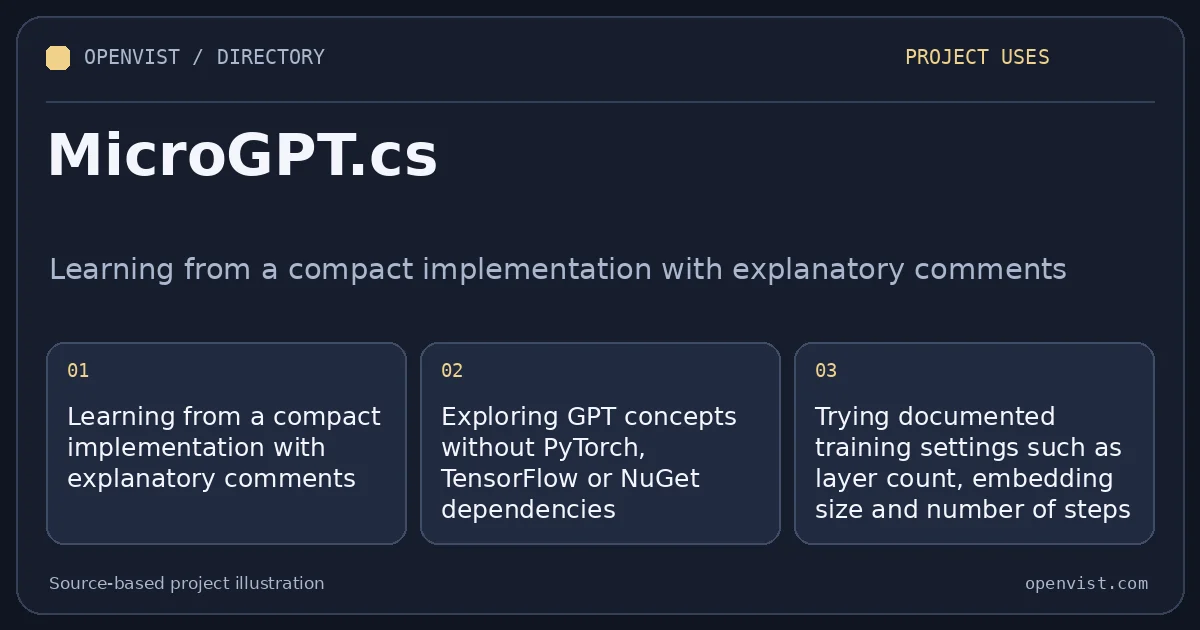
- C# developers exploring how a GPT language model is implemented.
- Learners studying automatic differentiation, backpropagation and transformer components.
- Developers experimenting with small-scale language-model training and text generation.
Documented uses
- Train a small character-level GPT on a list of human names.
- Generate new name-like text from the trained model.
- Study how tokenization, attention, an MLP, automatic differentiation and optimization fit together in a GPT implementation.
- Adjust documented model and training settings through command-line arguments.
Before you choose
Requirements & limits
The repository is public, identifies an MIT license and documents .NET 10.0 as its platform requirement.
- The example uses character-level tokens and trains on human names, producing name-like samples rather than a general-purpose chat model.
- The project includes its own scalar autograd engine and neural-network building blocks in C#.
- The README describes the implementation as educational and notes that it processes one number at a time instead of using GPU-parallel computation.
- The quick start and documented settings use the .NET CLI.
Check current requirements in the official documentation. Source-based guidance does not mean OpenViST has run or independently tested this project.
Source-based practical guide
Run the documented GPT training and generation example
Start the project with its default settings to train the small model and generate name-like samples.
Before you start
- .NET 10.0
- A local copy of the repository
- A command-line shell with the .NET CLI
Steps
Open a shell in the repository.
Change directory to src/AutogradEngine.
Run dotnet run.
Expected outcome
The README describes training output followed by generated name-like samples.
Guide limitations
- The example is a small educational model, not production code.
- The implementation processes one number at a time rather than using GPU-parallel computation.
Evidence and transparency
Sources & review
Source record details
- Source availability
- Active
- Sources checked
- 15 November 2026
- Original website title
- milanm/AutoGrad-Engine · Official homepage title · retained in its source language