
Understand the project
Practical overview
When it fits
Use Wavediff when you need a research codebase for wavelet-based diffusion experiments and can prepare the required datasets and GPU environment.
Who it is for
- Researchers reproducing or studying wavelet-based diffusion image generation.
- Developers building self-hosted image-generation experiments around PyTorch.
Documented uses
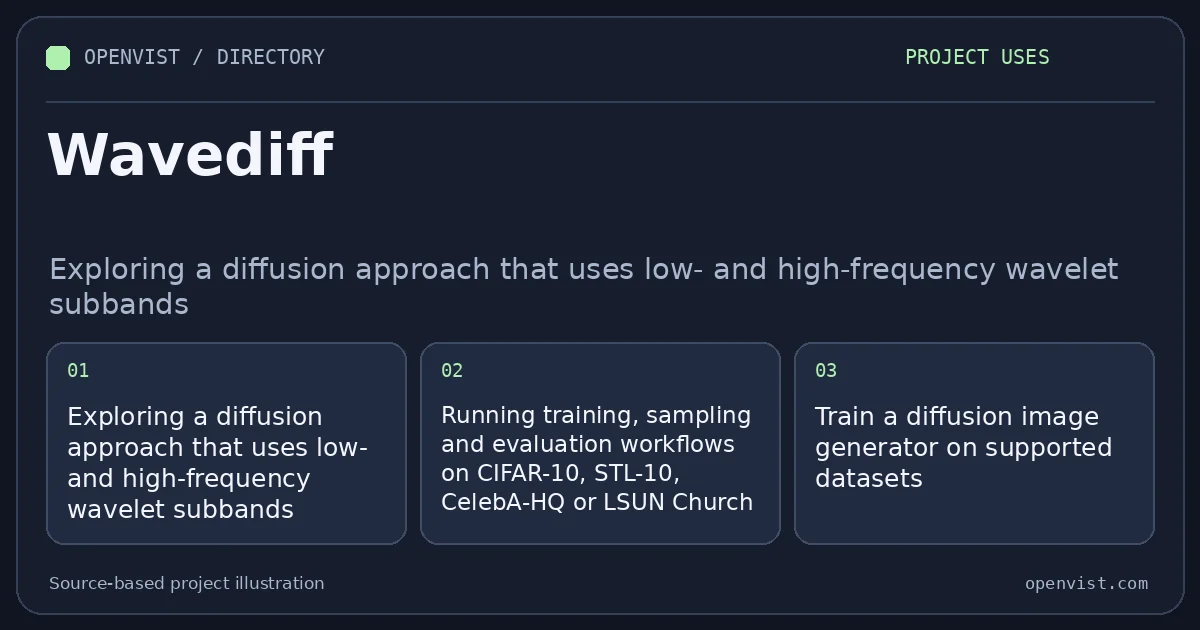
- Train a diffusion image generator on supported datasets.
- Generate image samples using testing mode and available pretrained checkpoints.
- Evaluate generated samples with the documented FID and Recall workflows.
Before you choose
Requirements & limits
The public repository lists an AGPL-3.0 license.
- The implementation specifies Python 3.7.13 and PyTorch 1.10.0.
- Training GPU allocations in the README range from one to eight GPUs by dataset; testing instructions specify one GPU.
- CIFAR-10 and STL-10 download on first execution, while other datasets require separate preparation.
- Pretrained checkpoints and reported results are listed in the repository for several datasets and resolutions.
Check current requirements in the official documentation. Source-based guidance does not mean OpenViST has run or independently tested this project.
Source-based practical guide
Install the WaveDiff Python environment
Create and activate the Conda environment specified for WaveDiff.
Before you start
- Conda
- The WaveDiff repository, including its environment.yml file
Steps
From the repository, create the environment with
conda env create -f environment.yml.Activate it with
conda activate wavediff.
Expected outcome
The `wavediff` Conda environment is active.
Guide limitations
- The implementation specifies Python 3.7.13 and PyTorch 1.10.0.
- The alternative requirements.txt installation and separate pytorch_wavelets instructions are described in the repository README.
Evidence and transparency
Sources & review
Source record details
- Source availability
- Active
- Sources checked
- 14 November 2026
- Original website title
- VinAIResearch/WaveDiff · Official homepage title · retained in its source language