
Practical overview
When it fits
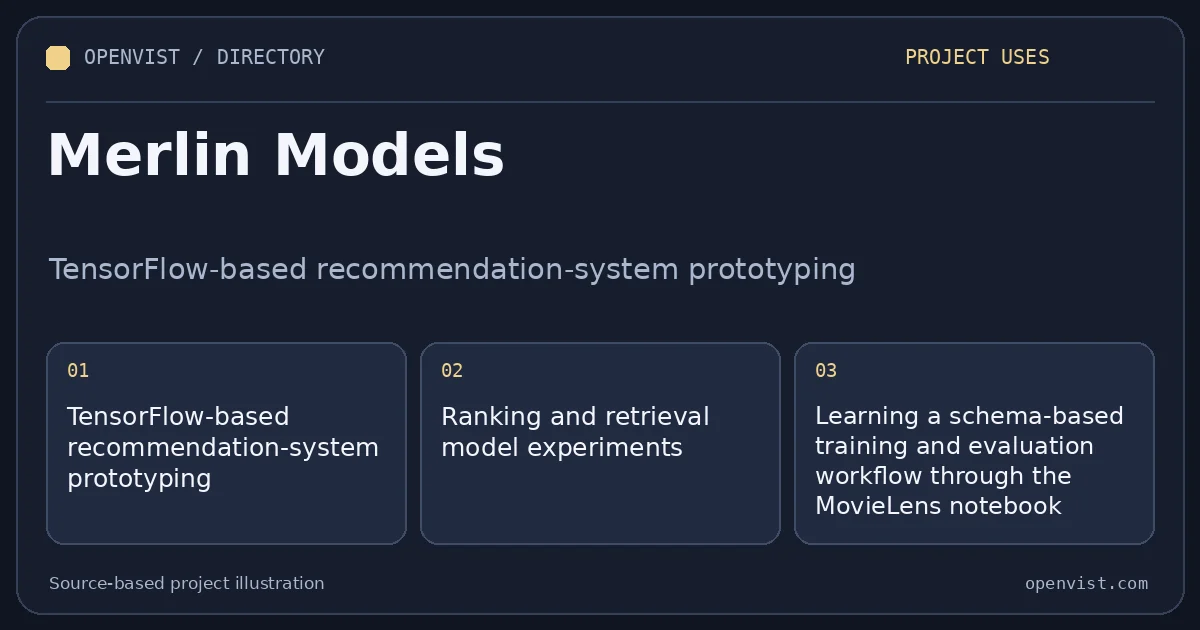
Use Merlin Models when building or experimenting with TensorFlow recommendation systems and you need documented ranking or retrieval architectures, model components, or a concrete training-and-evaluation example.
Who it is for
- Data scientists and machine-learning engineers developing recommendation models.
- Researchers prototyping or benchmarking recommendation architectures.
Documented uses
- Prototype a recommender using standard architectures such as DLRM, DeepFM or Wide & Deep.
- Develop ranking models using documented model constructors and reusable components.
- Explore retrieval approaches such as matrix factorization, two-tower and YouTube-DNN models.
- Train and evaluate a recommendation model using the documented MovieLens example.
Requirements & limits
- The documented examples and model constructors are TensorFlow-oriented.
- The MovieLens workflow relies on data columns and schema tags to identify features and prediction targets.
- The API spans distinct recommendation tasks, including ranking and retrieval, so model choice should follow the intended task.
Check current requirements in the official documentation. Source-based guidance does not mean OpenViST has run or independently tested this project.
Train and evaluate a DLRM model with MovieLens
Follow the documented notebook workflow to prepare MovieLens data, train a DLRM recommender and evaluate it.
Before you start
- TensorFlow and the Merlin Models library, as used by the notebook's Merlin TensorFlow container.
- MovieLens data loaded using the documented get_movielens convenience function.
Steps
Load and preprocess the MovieLens ml-1m variant with get_movielens, which returns training and validation datasets.
Use the training schema to define a DLRM model, selecting the rating_binary target as shown.
Compile the model with the Adam optimizer and train it on the training dataset.
Evaluate the trained model on the validation dataset and inspect the returned metrics.
Expected outcome
A trained DLRM model and validation metrics for the notebook's binary rating prediction example.
Guide limitations
- The example is specific to its MovieLens schema and target setup; another dataset needs appropriate schema and target preparation.
- Users are responsible for checking dataset contents and applicable licenses for their intended use.
Sources & review
Source record details
- Source availability
- Active
- Sources checked
- 14 November 2026
- Original website title
- Merlin Models — NVIDIA Merlin Models · Official homepage title · retained in its source language