
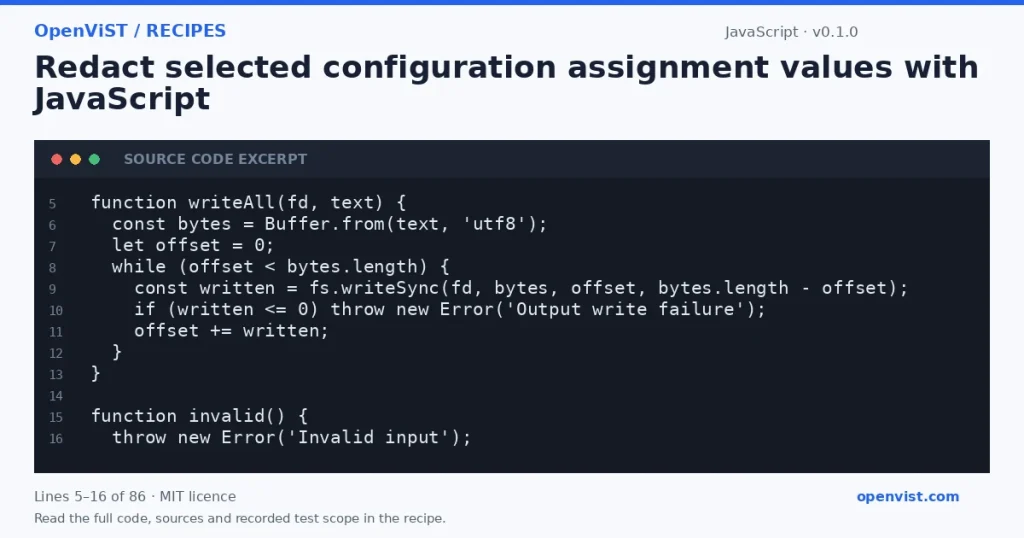
Replace every value assigned to an explicit selected key while preserving the order and literal values of unselected assignments. Uses saved stdin text; never reads the real process environment.
Before you start
- Save the code as redact.cjs and run node redact.cjs with the protocol supplied on stdin. No CLI arguments are accepted. Requires Node.js 22 and only requires node:fs.
- Provide selector keys, exactly one line containing ---, then KEY=value assignments. Empty lines and lines starting with # are ignored without trimming.
- Keys must match ASCII [A-Za-z_][A-Za-z0-9_]{0,63}. Selectors must be unique. At most 100 selectors and 100 assignment records are accepted.
- Input is read from descriptor 0 using readSync with a cumulative maximum of 65537 bytes; inputs larger than 65536 bytes are rejected. Strict UTF-8 decoding retains any BOM so a leading BOM can be explicitly rejected.
- CR, NUL, other ASCII controls except LF, and DEL are rejected everywhere. The total UTF-8 length of original assignment values, including duplicates, must not exceed 1024 bytes.
- The complete input is validated before stdout is written. Success emits exactly one JSON object followed by LF, exits 0, and leaves stderr empty. Invalid arguments, input, UTF-8, or stdin reads produce only error: invalid input followed by LF on stderr and exit 2.
- Example stdin: TOKEN\n---\nTOKEN=example\nLABEL=hello=world\nTOKEN=\n
- Example stdout: {"assignments":[{"key":"TOKEN","value":"[REDACTED]"},{"key":"LABEL","value":"hello=world"},{"key":"TOKEN","value":"[REDACTED]"}]} followed by LF.
Build and check
- Save the example as recipe.cjs.
- Prepare input.txt with selectors, a --- separator and literal assignments; use synthetic values while learning.
- Run the documented command and inspect the JSON output.
- Exit 2 indicates rejected input; no successful JSON result is emitted.
Limits to understand
- This is a literal LF-only protocol, not general dotenv syntax. Quotes, spaces, backslashes, # characters, and additional equals signs in values are literal.
- Only explicitly selected keys are redacted. Unselected values remain in output; this is not automatic secret detection or a safe-to-publish certification.
- Assignment order and duplicates are preserved. No key-name arrays are emitted, so no key-name sorting is applicable.
- There are no file, environment, network, subprocess, or dynamic-execution operations. Filesystem calls only read stdin and write stdout or stderr through their existing descriptors.
- Output-write and allocation failures are outside the input-error guarantee.
- Literal assignment subset only; no quoting rules, export syntax, interpolation, multiline values or general dotenv compatibility.
- Unselected assignment values are emitted unchanged. Review output before sharing.
- stdin may block until EOF; input is bounded to 65536 bytes and 100 selector / 100 assignment records. Total assignment-value bytes are limited to 1024.
Run it
node recipe.cjs < input.txtExample input
TOKEN
---
TOKEN=secret-one
HOST=localhost
TOKEN=secret-two
Expected output
{"assignments":[{"key":"TOKEN","value":"[REDACTED]"},{"key":"HOST","value":"localhost"},{"key":"TOKEN","value":"[REDACTED]"}]}