
Replace every value assigned to an explicit selected key while preserving the order and literal values of unselected assignments. Uses saved stdin text; never reads the real process environment.
Before you start
- Save the code as redact.py and run with Python 3.12 using no CLI arguments: python3.12 redact.py. Supply the protocol text through standard input.
- Uses only sys and json. Performs one bounded stdin read of 65537 bytes, rejects input exceeding 65536 bytes, and strictly decodes UTF-8.
- Requires exactly one literal --- separator line. Rejects a leading BOM and prohibited controls anywhere. Ignores only empty lines and lines starting with #; whitespace is not trimmed.
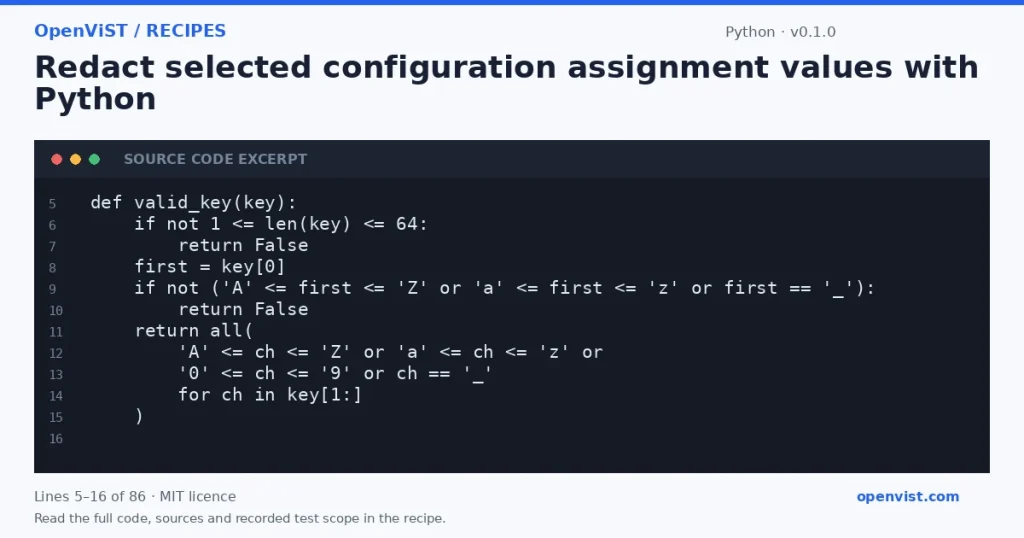
- Validates ASCII key syntax, unique selectors, at most 100 selectors, at most 100 assignment records, and at most 1024 total UTF-8 bytes across original assignment values, including duplicates and selected values.
- Preserves assignment order, duplicate assignments, and all unselected values. Replaces every selected assignment value, including an empty value, with [REDACTED].
- Validates the complete input before producing successful stdout. Success writes exactly one JSON object followed by LF using ensure_ascii=True, exits 0, and leaves stderr empty. Invalid input, arguments, UTF-8, or stdin read failure produces only error: invalid input followed by LF on stderr and exits 2.
- No output key-name arrays are produced; assignment records remain in input order.
Build and check
- Save the example as recipe.py.
- Prepare input.txt with selectors, a --- separator and literal assignments; use synthetic values while learning.
- Run the documented command and inspect the JSON output.
- Exit 2 indicates rejected input; no successful JSON result is emitted.
Limits to understand
- This is a literal LF-only assignment protocol, not a general dotenv parser. Quotes, backslashes, spaces, # characters within values, and additional = characters are preserved literally.
- Only explicitly selected keys are redacted. Unselected values remain visible; this is neither automatic secret detection nor certification that output is safe to publish.
- The CLI reads no files, environment variables, credentials, or host configuration and performs no network access, subprocess execution, or dynamic execution.
- Output-write and allocation failures are outside the input-error guarantee.
- Literal assignment subset only; no quoting rules, export syntax, interpolation, multiline values or general dotenv compatibility.
- Unselected assignment values are emitted unchanged. Review output before sharing.
- stdin may block until EOF; input is bounded to 65536 bytes and 100 selector / 100 assignment records. Total assignment-value bytes are limited to 1024.
Run it
python3 recipe.py < input.txtExample input
TOKEN
---
TOKEN=secret-one
HOST=localhost
TOKEN=secret-two
Expected output
{"assignments":[{"key":"TOKEN","value":"[REDACTED]"},{"key":"HOST","value":"localhost"},{"key":"TOKEN","value":"[REDACTED]"}]}