
Measure delimiter occurrences without interpreting quoted values or assignment syntax. Work only with supplied input; this does not contact external services or modify input.
Before you start
- Save the code as recipe.rs. Compile with Rust 1.99.0 using: rustc --edition=2021 recipe.rs -o recipe
- Run recipe with input supplied through stdin and no CLI arguments. All arguments, including help flags, are rejected.
- Reads at most 65537 bytes from stdin and rejects input exceeding 65536 bytes. Requires strict UTF-8, rejects a leading UTF-8 BOM, and rejects every CR character, including CRLF line endings.
- Splits only at LF and discards exactly empty segments. Retains whitespace-only segments unchanged. Before counting, validates that there are at most 100 retained lines and that each contains at most 256 UTF-8 bytes.
- Counts every literal U+003D equals sign in retained-line order, including occurrences inside quoted text. Performs no trimming, normalization, grouping, deduplication, or assignment parsing.
- Success exits 0, emits exactly one JSON object followed by a newline, and emits no stderr. Empty input or input containing only LF characters produces {"counts":[]}.
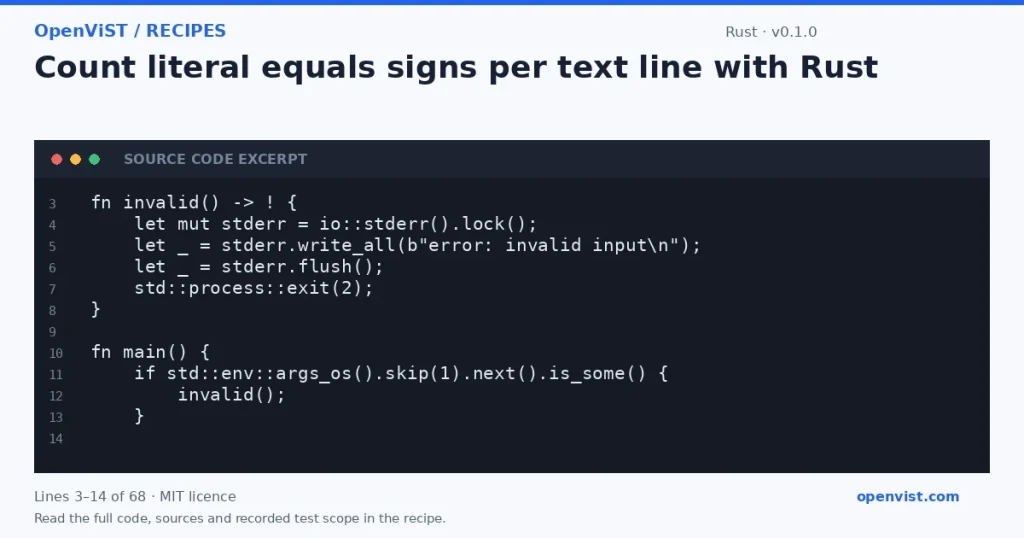
- Invalid arguments, invalid input, and stdin-read failures exit 2 with no stdout and exactly error: invalid input followed by a newline on stderr, subject to the failure limitations below. Diagnostics never include input values.
- Uses only the standard library, with explicit std::io imports. The only environment/process calls are std::env::args_os for argument rejection and std::process::exit for exit status.
Build and check
- Save the example as recipe.rs.
- Compile with Rust 1.99.0 using rustc --edition=2021 recipe.rs -o recipe.
- Prepare UTF-8 input.txt following the documented operation-specific conventions.
- Run ./recipe < input.txt.
- Inspect the JSON result. Exit 2 with exactly error: invalid input followed by a newline on stderr and no stdout identifies rejected input or stdin-read failure. Output-write failures may also exit nonzero, without that diagnostic and potentially after partial stdout; these are outside the input-error guarantee.
Limits to understand
- Stdin may block while waiting for data or EOF. Accepted input requires EOF; oversized input is rejected once the 65537th byte is read.
- Application storage includes a fixed 65537-byte input buffer, references to at most 100 retained lines, and a small output string. Overall application memory is O(input bound + retained-line count), plus standard-library buffering and allocator overhead.
- Line lengths are measured in UTF-8 bytes, not Unicode characters. Only a BOM at the beginning of the entire input is rejected as a BOM; later U+FEFF characters are ordinary text.
- Successful output reveals retained-line counts and per-line equals-sign frequencies, which may be sensitive even though original text is not printed.
- Memory-allocation failures and output-write failures are outside the input-error guarantee. A detected stdout write or flush failure exits 2 without an added diagnostic and may leave partial stdout. Stderr failures may prevent delivery of the required error message.
Run it
rustc --edition=2021 recipe.rs -o recipe
./recipe < input.txt
Example input
a=b
x==y
plain
Expected output
{"counts":[1,2,0]}